
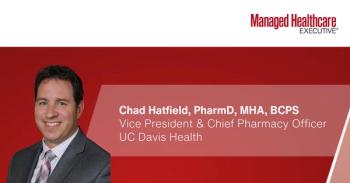
Chad Hatfield, Pharm.D., of UC Davis Health, says rebate model readiness starts with a spend review and data that pharmacy and IT can pull consistently.
Chad Hatfield, Pharm.D., of UC Davis Health, says rebate model readiness starts with a spend review and data that pharmacy and IT can pull consistently.
Chad Hatfield, Pharm.D., of UC Davis Health, says 340B savings fund free clinics and mental health care that could shrink as the program’s future shifts.
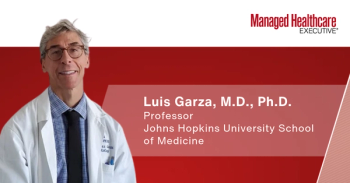
Luis Garza, M.D., Ph.D., a Johns Hopkins professor, says hidradenitis suppurativa is neither an infection nor a classic autoimmune disease but an auto-inflammatory condition.

Vision impairment affected 17.6% of 1,484 adult burn survivors in a study presented at AAO 2026, with age the strongest predictor of difficulty seeing.
Hidradenitis suppurativa is becoming more common, and a Johns Hopkins expert suspects an unidentified chemical in processed foods may be one reason.

A two-year study of 53 glaucoma patients logged nearly 4,800 home VR visual field tests, yet no insurance code currently covers home perimetry.

Reimagine Care's CEO says one-off hospital approvals slow CAR-T access and urges buyers to ask vendors to prove outcomes such as avoided ED visits.
The financial pain from your healthcare cost is real, you are uniquely placed to negotiate prices down, and hospitals, at 46% of spending, are where to look, says the CEO and president of the Health Care Cost Institute, which issued its annual cost and utilization report today.
Spending on prescription drugs grew by 40%, faster than spending on inpatient care, outpatient care and professional services, according to a new report from the Health Care Cost Institute.
A new Health Care Cost Instittue report finds prices, not utilization, drove spending growth in employer coverage from 2019 to 2023, echoing the group's very first report — and the title of Uwe Reinhardt's famous article.

Topical steroids remain first-line for chronic hand eczema, but long-term use can thin the skin and leave patients with poorly controlled disease.

Patients with HS should get three to four months on a biologic before a switch, says a dermatologist who sees promise in oral JAK inhibitors.
With three FDA-approved biologics for hidradenitis suppurativa, Jennifer Hsiao, M.D., said patient preference and access often decide which comes first.

Art Papier, M.D., CEO of VisualDx, says darker skin tones have been underrepresented in dermatology resources for decades and explains how his company works backward from known diagnostic errors.
How LLM decision support reshapes dermatology care, helping non-specialists diagnose while navigating trust gaps, ambiguity, and hallucination risks at Fall Clinical Derm.

Sagimet CEO David Happel shares insights on denifanstat, highlighting strong acne response, tolerability and optimism for a denifanstat U.S. trial.
Sagimet CEO David Happel says oral denifanstat could sharply cut antibiotic use in acne and be used before patients ever need isotretinoin.
Reimagine Care and Dan Nardi scale CAR-T programs with remote cancer care, AI triage and nurses, as the Cureety partnership tackles staffing and access.

Biosimilars can cost $600 a month versus $6,000 for branded rivals, but PBM rebate incentives push formularies toward pricier drugs, says Christine Johnston.
Dan Nardi shares how Reimagine Care uses AI triage and connected devices to scale outpatient cancer support, enabling faster, personalized symptom monitoring.

Dunn of NeosRx says a 340B shift from discounts to rebates likely won't affect rebate erosion affecting plan sponsors.

Five transcranial magnetic stimulation sessions in one day improved processing speed in adults with schizophrenia, which holds promise for future treatment possibilities, according to researcher Heather Burrell Ward, M.D.
Steering claims away from 340B-eligible pharmacies is one option but also the most disruptive, said Jeff Dunn, Pharm.D., MBA, of NeosRx.
340B discounts preclude rebates paid to pharmacy benefit managers for their payer clients. Dunn says new transparency and cost pressures have created awareness of “340B rebate erosion.”
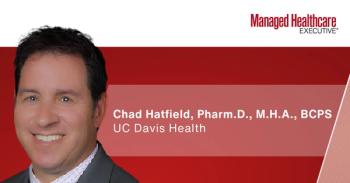
Chad Hatfield, Pharm.D., M.H.A., BCPS, vice president and chief pharmacy officer of UC Davis Health, says pharmacists are embedded in “nearly all specialties," with more than 150 holding board certification.

Sova, a clinical advisor for Employers Health, expects more employers to exclude GLP-1s for obesity but urges a look at coverage for specific cardiometabolic conditions.
Employers Health’s Alexis Sova says employers excluding GLP-1s now lean on weight management programs and direct-to-employer deals, not a hard cutoff.

Poh says treatment of follicular lymphoma is entering an exciting era in follicular lymphoma with multiple treatment options and an opportunity to be selective according to what a patient wants from therapy.
The treatment landscape continues to evolve, Poh says, and move away from a one-size-fits-all approach toward more individualized treatment strategies.
Tafasitamab targets CD19, and epcoritamab targets CD20 and CD3, bringing T cells into close contact with the lymphoma cells, Poh notes.