


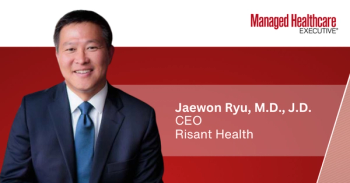
In the first segment of a video interview with MHE, the CEO of Risant Health discusses the role of scale in following value-based practices.

Peter Wehrwein has been the lead editor of Managed Healthcare Executive since February 2020.
In the first segment of a video interview with MHE, the CEO of Risant Health discusses the role of scale in following value-based practices.

Risant’s CEO, Jaewon Ryu, M.D., J.D., discusses some of the early successes of bringing a set of Kaiser Permanente’s value-based care practices to Risant's health systems—Geisinger Health in Pennsylvania and Cone Health in North Carolina. Consistency and "systemness” are key.

By accommodating the Trump administration's most favored nation drug pricing agenda, the pharmaceutical industry has avoided tariffs and seems likely to do so after the Supreme Court ruling last week.

The role of the pharmacist, managed care pharmacist job satisfaction and artificial intelligence were among the topics that Susan A. Cantrell, CEO of the Academy of Managed Care Pharmacy, discussed with Perry Cohen, Pharm.D., in this episode of "Conversations with Perry and Friends."

The deals that drugmakers have struck in response to Trump's most favored nation pricing policies may not be affected, partly because the president has authority to impose tariffs under other statutes.

And amid the ads for Pringles, Pepsi and Ritz crackers, boxer Mike Tyson appears in a MAHA ad inveighing against processed foods.

PBM reform has finally made its way through Congress and was signed into law by President Donald Trump. Here are seven things you need to know about the law.
And what has it achieved? The meaning and achievements of managed care change with the times, the context, the goals — and in the eyes of the beholders.

PBM critics heaped praise on reforms. A communications official at the trade group should turn its attention to how the pharmaceutical industry stifles competition and keeps prescription drug prices high.


It’s plausible — there are GLP-1 receptors in the brain — and preclinical research has suggested possible benefits. But a review of the current medical literature shows uneven results in humans, and the studies have been small.

Chris Klomp, the director of Medicare and the deputy administrator at CMS, spoke about the proposed rule designed to curtail at-home risk assessments and other tactics that large insurers have used to game Medicare Advantage risk adjustment.

The trade associations salvos came the day before the CEOs of five major insurers are expected to face tough questioning at two congressional hearings.


Colton Jones, M.D., of The University of Texas San Antonio, discusses aspirin for colorectal cancer prevention after presenting research comparing GLP-1s with aspirin at the 2026 ASCO Gastrointestinal Cancers Symposium earlier this month in San Francisco.

Australian researchers say the first shot may temporarily damp down the immune system, giving the latent varicella zoster virus a chance to activate and cause mild cases of shingles.

In a wide-ranging interview, Mitchell discussed the Purchaser Business Group Health’s health data demonstration project, employer fiduciary responsibility, consequences of the end of enhanced Affordable Care Act subsidies and direct contracting.

People taking glucagon-like peptide 1 (GLP-1) drugs were 36% less likely to develop colorectal cancer than those taking aspirin, according to a real-world, head-to-head study.


The approval comes two months after Jascayd (nerandomilast) was approved for idiopathic pulmonary fibrosis.

Dupixent, Opzelura, and Zoryve were among the medications that had additional FDA-approved indications in 2025.

Trial results presented at the annual meeting of the American Society of Hematology showed decided advantages of Hympavzi (mastacimab) over on-demand treatment with bypassing agents.


Clinicians are moving toward managing mild (Grade 1) cytokine release syndrome on an outpatient basis.

As the number of patients with multiple myeloma and lymphoma treated with CAR-T therapy increases, health systems are shifting post-infusion care from inpatient to outpatient settings. Research presented at the annual meeting of the American Society of Hematology shows the change slices costs by $19,180.


The chief medical officer of Genetix Biotherapeutics, formerly known as Bluebird bio, discusses timelines and operational challenges of the gene therapies Zynteglo for beta thalassemia and Lyfgenia for sickle cell disease.

The patient died from vent-occlusive liver disease, a well-characterized side effect of the busulfan, the myeloablative chemotherapy used to prepare the bone marrow for engraftment with the Casgevy-modified blood stem cells.