
Opinion|Videos|August 31, 2026
Real-World Safety Experience and Clinical Takeaways from the BE BOLD Trial
Author(s)Philip Mease, MD, MACR, Saakshi Khattri, MD
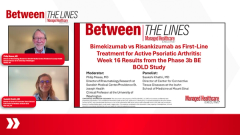
Continuing the Managed Healthcare Executive Between the Lines series, Philip Mease, MD, of Swedish Medical Center, Providence St. Joseph Health, and the University of Washington, asks Saakshi Khattri, MD, of the Icahn School of Medicine at Mount Sinai, to reflect on her real-world experience with bimekizumab's safety profile and the broader clinical takeaways from the BE BOLD trial.
Advertisement
Episodes in this series

Continuing the Managed Healthcare Executive Between the Lines series, Philip Mease, MD, of Swedish Medical Center, Providence St. Joseph Health, and the University of Washington, asks Saakshi Khattri, MD, of the Icahn School of Medicine at Mount Sinai, to reflect on her real-world experience with bimekizumab's safety profile and the broader clinical takeaways from the BE BOLD trial.
Dr. Khattri confirms that her practice mirrors the trial data, with no notable signal for serious infections, MACE events, or malignancy. When counseling patients starting bimekizumab, she flags the risk of oral, mucocutaneous yeast infections specifically, taking care to clarify that this is not genital candidiasis, a distinction she says helps avoid unnecessary alarm. Drawing on her internal medicine background, she notes that oral thrush is mild to moderate and straightforward to manage with nystatin swish-and-spit or oral fluconazole, adding that she hasn't had to discontinue bimekizumab in any patient for this reason, and that incidence tends to decline with continued treatment. Turning to the 16-week data as a whole, Dr. Khattri highlights that bimekizumab's IL-17A/F inhibition met the trial's primary ACR50 endpoint against risankizumab's IL-23 inhibition, demonstrating superiority in patients with active PSA. She frames this in the context of the many systemic therapy options available, noting that treatment choice still depends on a patient's specific disease domains and prior therapy, but that having head-to-head data now gives clinicians a clearer basis for comparison. Asked how this changes her own practice, she says it's a nuanced call, but that bimekizumab is now a therapy she offers as first-line treatment for patients with active PSA. Dr. Mease agrees that head-to-head data like this is valuable precisely because it allows for more direct, evidence-based conversations with patients.
Final thoughts and closing perspectives from Dr. Mease and Dr. Khattri will be shared in the next segment.
Advertisement
Related to this article

As the pharmacist pipeline tightens, leaders from UC Davis Health, UCSF Health, and Sutter Health say financial sustainability now depends as much on capacity as on cost.

GLP-1 use in adults 65 and older with MASLD was linked to a 45% lower risk of death, and a 28% lower risk of hepatic decompensation, a new Houston Methodist Research Institute study shows.

New data from Sutter Health suggest the real gap in GLP-1 access is physician awareness, not insurance coverage — and fixing it closed outcome disparities across every racial and ethnic group.

Research findings presented at the CHEST meeting show that false positives may make patients more adherent to screening. Qualitative research shows that patients want more explanation and results communicated verbally.

David Chen, PharmD, explains how physician-led formulary decisions — not rebates — power Kaiser Permanente’s biosimilar strategy, and why he thinks other health systems could do the same.

10 research abstracts presented at the CHEST meeting are split on whether hospital admission during the weekend is assoicated with worse outcomes than admission on weekdays.

Research findings scheduled to be presented at the CHEST meeting show broad positive cardiopulmonary effects from GLP-1s and an association with a reduced risk of acute respiratory failure.
Chad Hatfield, Pharm.D., of UC Davis Health, says 340B savings fund free clinics and mental health care that could shrink as the program’s future shifts.
Advertisement
Advertisement
Trending on Managed Healthcare Executive
1
Kaiser’s formulary chief makes his case for a ‘total value’ model on biologics | HSES 2026
2
Long-acting lenacapavir plus cabotegravir kept all 46 patients with HIV virally suppressed in recent trial
3
More pluses for GLP-1s for obstructive sleep apnea | CHEST 2026
4
Chad Hatfield, Pharm.D., on the 340B uncertainty facing health systems| HSES 2026
5