Now Playing
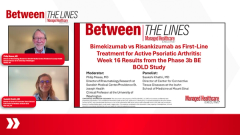
Welcome back to another Managed Healthcare Executive Between the Lines series. In this opening episode, moderator Philip Mease, MD, Director of Rheumatology Research at Swedish Medical Center, Providence St. Joseph Health, and Clinical Professor at the University of Washington, is joined by Saakshi Khattri, MD, Director of the Center for Connective Tissue Diseases at the Icahn School of Medicine at Mount Sinai, to lay the groundwork for a discussion on the BE BOLD head-to-head trial of bimekizumab versus risankizumab in active psoriatic arthritis (PSA).
Dr. Khattri opens by outlining the clinical and economic burden of PSA, noting that the disease carries both direct costs, including expensive biologic therapies, and significant indirect costs from lost productivity, as active disease keeps patients from work and daily activities. She emphasizes that the burden can't be reduced to a single dollar figure since it varies so widely based on disease activity and treatment response, but stresses that the lack of head-to-head biologic comparisons in rheumatology makes the BE BOLD data especially notable. Dr. Mease adds population-level context, noting that psoriasis affects roughly 3% of the U.S. population and that psoriatic arthritis develops in about 30% of those patients, making it a substantial public health concern. He also describes PSA's multi-domain impact, spanning skin disease, joint and spine involvement, and enthesitis, underscoring why it represents such a significant burden to patients and society alike. The conversation then turns to the current treatment landscape, with Dr. Khattri walking through the more than a dozen FDA-approved systemic therapies now available for PSA, including oral PDE4 and JAK inhibitors, a newly approved TYK2 inhibitor, and biologics spanning TNF, IL-23, IL-17, and dual IL-17A/F inhibition, and explaining why treatment selection depends heavily on which disease domains a patient presents with.
The discussion sets up the next segment in the series, where Dr. Mease and Dr. Khattri turn to when biologics are used in practice, comparing how quickly clinicians in academic centers versus community settings move patients from conventional synthetic DMARDs to biologic therapy, before diving into the design of the BE BOLD study itself, including its patient population, randomization, dosing, and the primary and secondary endpoints that will set up the head-to-head efficacy and safety data to follow.