


Opinion|Videos|August 17, 2026
Real-World Usage of Biologics in Psoriatic Arthritis
Author(s)Philip Mease, MD, MACR, Saakshi Khattri, MD
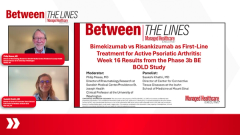
Continuing the Managed Healthcare Executive Between the Lines series, moderator Philip Mease, MD, of Swedish Medical Center, Providence St. Joseph Health, and the University of Washington, and guest Saakshi Khattri, MD, of the Icahn School of Medicine at Mount Sinai, shift from the broader disease burden discussion to how biologics are actually being used in practice today, before laying out the design of the BE BOLD trial.
Advertisement
Episodes in this series

Continuing the Managed Healthcare Executive Between the Lines series, moderator Philip Mease, MD, of Swedish Medical Center, Providence St. Joseph Health, and the University of Washington, and guest Saakshi Khattri, MD, of the Icahn School of Medicine at Mount Sinai, shift from the broader disease burden discussion to how biologics are actually being used in practice today, before laying out the design of the BE BOLD trial.
Dr. Khattri describes her own prescribing pattern in New York City, where she's often able to start active psoriatic arthritis (PSA) patients on a biologic as first-line systemic therapy, a shift from the older paradigm of trying methotrexate or another conventional synthetic DMARD first. Dr. Mease notes the same trend holds even outside major academic hubs, pointing out that methotrexate alone often falls short on both efficacy and tolerability, and that the latest ACR guidelines now support using a biologic ahead of methotrexate. Dr. Khattri adds a practical note on access: when payers push back on biologics as first-line PSA therapy, she can sometimes secure approval through a patient's psoriasis diagnosis instead, since methotrexate isn't standard treatment for skin disease. The conversation then turns to the BE BOLD trial itself, the first head-to-head study of bimekizumab, a dual IL-17A/F inhibitor, and risankizumab, an IL-23 inhibitor, using a joint-centric ACR50 response as its primary endpoint. Dr. Mease walks through the Phase 3b, multicenter design, presented at the recent EULAR meeting in London, including its 553 adult participants, who were either biologic-naive or had an inadequate response to a prior TNF inhibitor, the 1:1 randomization to each drug at labeled dosing, and the hierarchy of secondary endpoints, including minimal disease activity, ACR50 plus PASI100, an early ACR50 read at week 4, and DAPSA low disease activity or remission. Dr. Khattri weighs in on how closely the trial population mirrors her own patients and explains why raising the efficacy bar from ACR20 to ACR50, along with capturing response as early as week 4, matters for setting realistic expectations with patients.
Up next, Dr. Mease and Dr. Khattri dig into the actual BE BOLD data, breaking down how bimekizumab and risankizumab performed head-to-head across these efficacy and safety endpoints.
Advertisement
Related to this article

In this discussion, Ohio State economist Eric Seiber, Ph.D., explains how inconsistent claims-data definitions can skew estimates of first-episode psychosis and why standardization matters for early treatment and sustainable payment models.

CMS’ mandatory GLOBE drug model ties some Medicare Part B rebates to global prices, but cuts projected savings sharply amid shifting Part D premiums.

Bill Kerr of Avalon Heath Solutions says incorporating Z codes into CPT codes for lab and genetic testing would add needed specificity, reduce waste and possibly head off fraud.

States have to turn that information into medical frailty determinations that are clinically credible, consistent, and workable across large Medicaid populations.

A meta-analysis found steatotic liver disease in 75% of patients with sleep-disordered breathing and that CPAP lowered liver enzymes but not liver fat.

Some predicted that drugmakers might boost launch prices to make up for Medicare drug negotiations shrinking profits. Harvard researchers find no evidence of that happening so far.

State PBM reform accelerates through 2026, with Theresa Carnegie of Mintz unpacking new laws, rebate pass-through, spread pricing bans, and compliance risks.

Only 19.1% of commercially insured patients with first-episode psychosis were adherent to antipsychotics in the year after starting treatment.
Advertisement
Advertisement
Trending on Managed Healthcare Executive
1
FAQ: State PBM reform in 2026—What's new since spring
2
CMS defined a path for medical frailty. Now comes the hard part.
3
IRA drug price negotiation has not increased launch prices, study finds
4
When the referral isn't the finish line: Making SDOH programs actually close care gaps
5