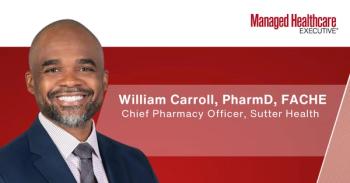
Will Carroll, Pharm.D., of Sutter Health says future pharmacy leaders need business, finance and AI skills, and health systems need real sponsorship.
Rebates aren’t disappearing, but PSG's 2026 survey suggests payers increasingly favor lower net costs, biosimilars and price transparency over traditional specialty drug rebate programs.
Payers are beginning to make small steps away from rebates for specialty drugs, finds a new survey from Pharmaceutical Strategies Group (PSG). Rebates are not going away, but the 2026 Trends in Specialty Drug Benefits survey suggests several trends are converging that could erode parts of the rebate model.
First, some pharmaceutical manufacturers are lowering their list prices rather than offering rebates, particularly in Medicare. Second, biosimilar competition is driving prices down in categories such as inflammatory conditions, where Humira and Stelara biosimilars are introducing real alternatives at dramatically lower costs.
Third, market price visibility is growing. When members can see that a biosimilar is available for under $1,000 through direct-to-consumer programs like Mark Cuban's Cost Plus Drugs, they start asking pointed questions about why their cost-share is so high and putting pressure on employers and plans to explain their formulary decisions.
“We cannot predict today that all rebates are going away,” Renee Rayburg, R.Ph., VP of clinical strategy at PSG, said in an interview. “But what people have counted on for the rebates is different. There's definitely a shift toward more strategy in the net cost realm.”
Health plans, the PSG survey found, reported somewhat greater interest than employers in pursuing alternatives to rebates. Compared with last year, interest in accepting lower rebate guarantees in exchange for the ability to implement more utilization management controls has increased.
“Rebates are hard to move away from, but we are seeing increased appetite for leaning into the strategies that will best help payers manage their plan versus prioritizing rebates above all else,” Morgan Lee, Ph.D., VP of research and marketing at PSG, said in an interview.
She said PSG has seen for several years an increasing trend to prefer a lower list price instead of a rebate. This year, they asked respondents about rebates compared with utilization management efforts. Payers were interested in passing some or all rebates to members at the point of sale. Health plans reported somewhat greater interest than employers in each alternative except for passing rebates to members at the point of sale.
“With transitioning away from rebates, payers have to figure out what their lowest-cost drugs are and how you report that value back to their leaders,” Rayburg said.
The survey found that although most payers are not interested in decreasing the use of utilization management, such as prior authorization and step therapy, they are concerned about unintended consequences. Overall, respondents expressed moderate concern about member dissatisfaction and delays in initiation of therapy and somewhat lower concern about prescriber dissatisfaction, poorer clinical outcomes, and health disparities among members. Employers expressed slightly higher levels of concern than health plans about poorer clinical outcomes and health disparities.
Biosimilar strategies
Rayburg said that because of the Inflation Reduction Act’s Maximum Fair Price, manufacturers are lowering their prices across the board, not just for Medicare, and are no longer giving rebates. She also said the launch of biosimilars for Humira (adalimumab) and Stelara (ustekinumab) is leading payers to reconsider the lowest net price.
The PSG report cites data showing that utilization of biosimilars has been increasing from 27.3% in 2023 to 36.7% overall in 2024. Excluding the Humira biosimilars, utilization has increased from 48.6% in 2023 to 54.2% in 2024.
The PSG survey found that PBMs are rapidly increasing their biosimilar strategy, including more than two-thirds of respondents reporting use of a lowest net cost strategy and/or mandatory biosimilars for patients new to therapy for at least one of the biosimilars covered under the pharmacy benefit or biosimilars covered under the medical benefit. PSG analysts suggest that mandatory conversion for patients already on a biologic to a biosimilar may not be far behind.
“With the shift away from rebates, organizations like PBMs may have to find other ways to define their value,” Rayburg said. “We’ve seen this with some of the smaller, newer PBMs, where they have different pricing models.”
PSG surveyed 228 benefits leaders representing employers, health plans, and unions/Taft-Hartley plans from Sept. 15, 2025, through Oct. 10, 2025. Employers represented 65% of those who were surveyed.
Other findings from the survey: