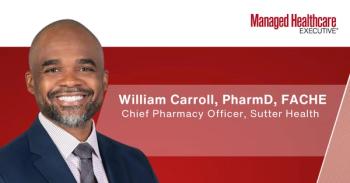
Will Carroll, Pharm.D., of Sutter Health says future pharmacy leaders need business, finance and AI skills, and health systems need real sponsorship.
AVAC Executive Director Mitchell Warren says HIV prevention science has never been stronger, even as funding cuts have left program infrastructure badly weakened.
HIV prevention science has never been stronger, but the funding and infrastructure needed to deliver it have been badly weakened, according to Mitchell Warren, executive director of AVAC, a U.S.-based organization that advocates for HIV prevention. Warren spoke with Managed Healthcare Executive ahead of the AIDS 2026, the 26th International AIDS Conference, a meeting sponsored by the International AIDS Society ((IAS), which opens Monday in Rio de Janeiro, Brazil.
"I think, in some ways, the science is stronger than ever to support the ambition of ending AIDS by 2030 as a public health threat," he said. "And yet, the cruel irony — it's coming at what had been a terrible political and economic situation a year ago, and it's gotten even worse."
The Global Fund to Fight AIDS, Tuberculosis and Malaria is now considering proposals for its next three-year funding cycle at a level about $5 billion below its December replenishment target, and some countries have been told the coming cycle will be their last round of Global Fund support, at a reduced amount. Warren also pointed to reduced transparency from the U.S. government on HIV program data, even as the Trump administration touted a 50% increase in its commitment to scale up lenacapavir for pre-exposure prophylaxis. At the beginning of 2025, the administration dismantled the United States Agency for International Development, which implemented many of the programs funded by U.S. President’s Emergency Plan for AIDS Relief (PEPFAR). PEPFAR funds that have gone to community programs for prevention have been curtailed or come with limitations.
In this interview with Managed Healthcare Executive, Warren discusses how health officials and others are trying to translate a wave of promising HIV prevention and treatment science into real-world impact at a time when program capacity has been badly strained because of U.S. cuts.
Warren said attendees at the IAS meeting can expect to hear about MK-8527, an investigational once-monthly oral pill for PrEP from Merck, as well as a longer-acting treatment pill that combines islatravir and lenacapavir. Researchers reported positive results from two phase 3 trials of the islatravir-lenacapavir combination at a press conference on Juy 21 highlighting the scientific findings scheduled to be presented at the meeting.