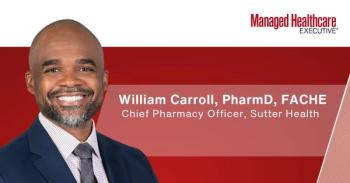
Will Carroll, Pharm.D., of Sutter Health says future pharmacy leaders need business, finance and AI skills, and health systems need real sponsorship.
Will Carroll, Pharm.D., of Sutter Health says pharmacy is often handed strategy to execute instead of shaping it, and must show value in C-suite terms.
The chief pharmacy officer role has changed significantly over the past five years, shifting away from running operations and toward shaping strategy, according to Will Carroll, Pharm.D., chief pharmacy officer at Sutter Health. Carroll spoke with Managed Healthcare Executive at the
Broader changes in healthcare have driven that shift, Carroll said. Pharmacy has moved from being viewed as a cost center toward being a revenue generator, particularly as care has expanded in the ambulatory space, and pharmacy has started to be included more in strategic planning upstream. Because pharmacy touches most patients across the whole continuum of care, he said, it is well positioned to help drive change.
Even so, pharmacy is often “given a strategic decision to execute versus being included upstream in the conversation,” Carroll said. Given its ability to improve access and extend provider reach, pharmacy should be leveraged to close gaps and provide services for patients. When it isn’t at the table, decisions are made in a silo, and pharmacy is handed a task without being used to the full extent of its ability to drive change.
Carroll doesn’t see that as senior leaders deliberately leaving pharmacy out. It depends on the maturity of the program, he said, and on pharmacy’s own persistence. Pharmacy is “like a health system within the health system,” and its leaders can get lost in its complexity. They need to be more intentional about being present in the room, speaking up to solve organizational challenges and proposing solutions rather than waiting on the sidelines for direction from senior leadership.
Part of earning that seat is speaking the C-suite’s language. “I think the first thing is not to assume that clinical impact is understood by the senior leaders,” Carroll said. Pharmacy leaders should translate clinical impact into operational and financial terms, such as shorter length of stay, freed-up physician and clinician time to see more patients, less time in the emergency department, better throughput and faster transitions of care. Those gains add up for both the patient experience and the organization’s financial performance, he said.
In this video, Carroll discusses how the CPO role has evolved and how pharmacy leaders can earn a place in strategic decision-making.