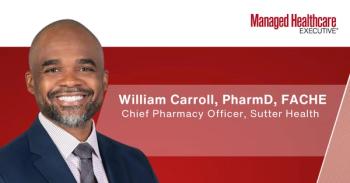
Will Carroll, Pharm.D., of Sutter Health says future pharmacy leaders need business, finance and AI skills, and health systems need real sponsorship.
A monthly pre-exposure prophylaxis (PrEP) pill would be less burdensome than daily pills and would be an important addition to the choices for HIV prevention, says Heffron, an HIV/AIDS researcher at the University of Alabama at Birmingham who is co-chairing a preconference meeting on HIV prevention today before the official start of the International AIDS Society meeting tomorrow in Rio de Janeiro, Brazil.
Merck has outlined initial plans to expand access to MK-8527, an investigational once-monthly oral HIV pre-exposure prophylaxis (PrEP) drug in phase 3 development, announcing seven nonexclusive, royalty-free licensing agreements with generic manufacturers that would cover 129 low- and middle-income countries if the drug is approved. The agreements, signed with three sub-Saharan African manufacturers and four Indian manufacturers, were announced ahead of AIDS 2026, the 26th International AIDS Conference in Rio de Janeiro in Brazil, and, according to Merck, mark the first time voluntary licenses for an HIV prevention product have been granted before a phase 3 trial finished enrolling.
In this interview with Managed Healthcare Executive (MHE). Renee Heffron, Ph.D., M.P.H., professor of medicine at the University of Alabama at Birmingham (UAB) and director of the UAB Center for AIDS Research, discusses why a once-monthly pill could address one of the most persistent barriers to PrEP uptake. “One of the struggles with daily PrEP is remembering to take something every day,” Heffron said, noting that a monthly option could ease that burden while still being dispensed through a pharmacy rather than requiring an injection, as with lenacapavir or cabotegravir.
Heffron is co-chair of a preconference meeting today on HIV prevention before the official start of the conference tomorrow. One of the themes of the preconference meeting is the importance of having an array of HIV prevention choices. In her interview with MHE, Heffron discussed the variety of ways in which prevention could be delivered.
Heffron also pointed to the manufacturing advantage a pill holds over injectable options. “The company has also said that the price could be potentially lower because a pill is easier and less expensive to manufacture than an injection,” she said, adding that another delivery option gives people more choice in how they protect themselves from HIV.
In a
“MK-8527 could be manufactured at extremely low cost, suggesting that intellectual property and licensing arrangements, rather than production feasibility, will determine equitable access in LMICs [low-income and middle-income countries],” Cross and his colleague wrote in the abstract of the study.