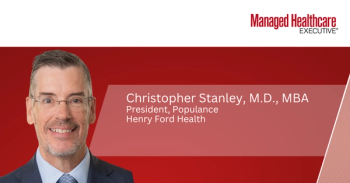
The first part of our conversation with Christopher Stanley, M.D., MBA, the president of Henry Ford Health's Populance and the newest member of the Managed Healthcare Executive editorial advisory board.
Value-based care has scored some cost-saving successes, says Christopher Stanley, M.D., MBA, president of Henry Ford Health's Populance. Health systems that build their own value-based care strategy, rather than adopting particular models one by one, will be in the best position to succeed, he says.
Value-based care and population health are facing some skepticism, with critics saying that the savings from efforts, particularly some of Medicare’s payment models, have been underwhelming. Christopher Stanley, M.D., MBA, president of Populance, the population health subsidiary of Detroit-based Henry Ford Health, said he remains a strong believer in the population health mindset and value-based approach, while acknowledging that some programs have not worked out as hoped.
Stanley, who recently joined the Managed Healthcare Executive (MHE) editorial advisory board, noted the CMS Innovation Center was intentionally created to test value-based care models, shut down the ones that don’t work, and improve the rest, and that some programs have since moved into standard CMS programs. He said research has shown that the primary Medicare accountable care organization (ACO) model, the Medicare Shared Savings Program that involves downside risk for ACOs, is effective.
In this segment of a wide-ranging interview with MHE, Stanley made a larger point about implementing value-based. “It’s foolish to build a capability or a business, or a strategy around a model,” said Stanley, because an organization that does so ends up chasing each program’s renewal cycle and incentives. Instead, he said, a health system should set its own strategy and participate in the models that are a god fit. The roughly 1 million members Populance expects to manage in January 2027 come through about 20 different contracts, he said, and handling each one separately would make little sense. Populance uses the same tools and care management approach across all of them, which makes any single program less important and makes it easier to walk away from arrangements that don’t fit, Stanley said.
Stanley explained why he considers culture change to be one of the biggest determinants of success with population health and value-based care. Many health systems, he said, still operate with a fee-for-service, “heads and beds” mentality that sees patients as a source of revenue, then hope for a bonus at the end of the year. When the bonus doesn’t come, he said, they blame the program instead of their own failure to change the culture.