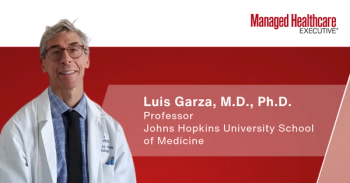
Luis Garza, M.D., Ph.D., a Johns Hopkins professor, says hidradenitis suppurativa is neither an infection nor a classic autoimmune disease but an auto-inflammatory condition.
Garza, an expert on hidradenitis suppurativa at Johns Hopkins, says increasing incidence of the disease on the Japanese island of Okinawa offer some "tantalizing clues" about reasons for the rising incidence.
Luis Garza, M.D., Ph.D., is a professor of dermatology at Johns Hopkins University School of Medicine in Baltimore and an expert on hidradenitis suppurativa (HS), a chronic skin condition characterized by nodules, abscesses and fistulae. The following is an excerpt from our interview with him.
This is an excerpt from the transcript of an interview Managed Healthcare Executive conducted with Garza. It has been edited for clarity.
One of the main challenges of HS is a delayed diagnosis. It’s very common. I think it’s becoming a little bit less common as HS becomes more recognized with its increasing incidence. As it becomes more common, doctors have more experience in the ER [emergency room] seeing it and recognizing it. I think the delays in diagnosis are getting shorter than they used to be, but they still there.
What we can do about it is to continue this trend of patients becoming more educated about their disease. I think with Google and now AI [artificial intelligence], folks are getting much more knowledgeable about their condition.
I definitely do think that the incidence is growing. We’ve done some research on this, and we’ve also done a lot of reading of the literature.
There’s this very interesting parallel with chloracne. There’s also a topical type of chloracne that could happen, where patients would literally get just acne on their faces from exposures to some chemicals. But if patients instead got a systemic exposure, they would get nodules and pus and bumps in their underarms and groin, which sounds just like HS. And it turned out that one of the things that caused chloracne was polychlorinated biphenyls, or PCBs, and [that contributed] to the outlawing of PCBs.
What we believe is that there’s something similar going on with HS … and we just have not discovered what it is. We think it might be related to something in processed foods because the increase kind of parallels [increased processed foods consumption].
There are some interesting chemical overlaps with PCBs and some types of bisphenols like BPA [bisphenol A]. Bisphenols are actually a big family. When there was a lot of concern about BPA about 10 to 15 years ago, people started switching to BPA substitutes.
What we wonder is if some of those substitutes actually might be that analogous chemical to PCBs. But we’re not sure.
In the meantime, we’re just telling patients to try to eat very conservatively and try to avoid processed foods — any foods that come from factories, even healthy sounding foods like protein shakes might be contaminated with chemicals that could be triggering HS.
It’s not been a workplace exposure.
There have been some tantalizing clues [about the exposure], which I find fascinating. My colleagues in Japan tell me that HS used to be very, very rare on the island of Okinawa because Okinawa has been one of the places that is a “blue zone” where people live really long and have super healthy life spans because they exercise a lot and they have a super healthy diet of fish, fruits, vegetables and whole grains. But interestingly, in the past 30 to 40 years, there’s been a lot of growth around the American bases in Okinawa and proliferation of American-like fast food and processed food. Now they’re starting to see more HS in Okinawa.
We hear anecdotal stories like this, where it looks like it really might correlate more with lifestyle than profession.
We know it’s not a classic infection for sure, and we do know that there is a strong genetic component. A lot of people tell us relatives are affected.
We have a model where we think there’s probably both a combination of a genetic kind of predilection and then an exposure that brings people over the top, and it’s a combination of both. And that’s why although lots of people eat processed foods, only some folks are getting HS.
We’re more bacteria than we are human if you count up the number of cells in our body, and we think we exist in a state of truce with most of that microbiome. But in the case of HS, we think that truce gets negated.
As the disease progresses, patients get these tunnels that form under the skin, so bacteria that normally don’t grow in the skin start growing in the skin. Though the bacteria didn’t start the party, they’re staying for the party, I joke.