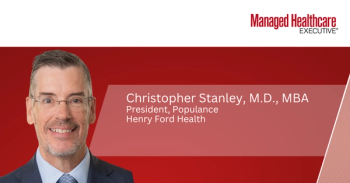
Unifying care management doubled patient outreach with the same staff, and virtual physical therapy is cutting costs, says Populance's Christopher Stanley, M.D.
The first part of our conversation with Christopher Stanley, M.D., MBA, the president of Henry Ford Health's Populance and the newest member of the Managed Healthcare Executive editorial advisory board.
First of two parts
Christopher Stanley, M.D., MBA, president of Populance, a population health subsidiary of Henry Ford Health, a health system headquartered in Detroit, has joined the Managed Healthcare Executive editorial advisory board. Stanley has more than 30 years of experience in healthcare leadership, including population health positions at Sutter Health and the Catholic Health Initiatives. He is a former Army major and was trained as a pediatrician.
This transcript has been edited for clarity and length.
You went to med school at the University of Missouri. Did you grow up in the Show-Me State?
I did indeed. I was born and raised in southwest Missouri in the Ozarks area. I grew up in a … small town, fairly rural, which influenced in some ways how I think about populations, healthcare and beyond. I went to undergraduate at what is now Missouri State University and medical school at the University of Missouri.
And why medical school for you? Were your parents involved in medicine or healthcare?
Absolutely not. They were great people — salt of the earth, very blue-collar people. My father, Hershel, was a city bus driver. Neither of my parents graduated college. My mother, Wilma, went a year to be a teacher. But there’s no healthcare at all in my family background.
I would say part of my interest was [that] I've always been stimulated by science and how things work — and people. The more that I was exposed to our local community physician, I realized not only could I learn and be stimulated, but I could really make a major difference in people's lives, [in] families and in communities. Medicine was this great combination of intellectual stimulation and giving back to the community.
You trained as a pediatrician, but you're also a former major in the Army. I know the Army has full medical services, and there are people in the Army with children, so presumably, there is a need for pediatricians. But pediatrics and the Army — you wouldn’t think that they go together.
You're right; it doesn't automatically connect together.
Coming from a humble upbringing, we did not have a lot of wealth [or] a lot of ability to fund schooling. I was lucky enough to get some scholarships for my undergraduate education and going to [the University of] Missouri …. I did not incur significant debt. But when I was looking to go into medical school, I realized this is a great investment. It's what I want to do, but I did start looking at what opportunities there [were] to help fund it so I wouldn't burden my parents. I had a friend who had received a military medical school scholarship, and I thought this [was] brilliant. It [met] my financial needs. And I have a very long family history, including my father, in the military, so I have a commitment to national service. So I brought the two together. I went to a civilian medical school but the military program within it, and one of the obligations is you need to do a military internship and residency.
I thought that I was going to be a proceduralist. I wanted to be a surgeon. I wanted to, in fact, be a plastic or a reconstructive surgeon, not for cosmetic purposes, but for other purposes. The more I did it, the more I realized that I really enjoyed the procedural aspect. I missed the patient connection aspect. You would do a procedure, and then that was it. You didn't have long, longitudinal relationships.
I did my pediatric rotation, and I loved it. I had no intention of being a pediatrician, but I loved the continuity. I loved the ability to actually cure most diseases in pediatrics. Adults — we drink, we smoke, we do bad things to our bodies. We always need people to help us out. But kids are so pure; all they want to do is go out and play. And I love the ability to change a life's trajectory for the next 60 or 70 years.
I ended up doing my pediatric residency in Hawaii at the Tripler Army Medical Center. Active-duty troops are very fertile, and they're having lots of kids. I had a great experience and a great opportunity there.
I did my payback time over in Germany for a few years. I saw babies to generals. I took care of anything and everything that needed to be taken care of, because that's the mission, and that's the community, and that's the service that I was providing. In the civilian world, you're trained to do this for pediatrics, and then you refer to a specialist here, here, here, here and here. In the Army, you are the doctor, so I took care of a lot of things that normally, as a pediatrician, you wouldn't.
When I got out of the military, I thought this was what healthcare [was]. I provided whatever care was needed for whatever age was needed, and I never had to do a fee-for-service bill. I was salaried. I was recognized as being a good doctor because I had great quality … [and] good bedside manner.
When I got into the civilian world, and I had to start doing fee-for-service billing, it seemed incongruous with what healthcare should be.
To some degree, that's what brought me into population health and value-based payment models. Just give me the dollar, the infrastructure and the system to do what needs to be done for patients and families in the community, and I will take accountability and responsibility.
When you were in Germany, were there any conflicts, and did you take care of wounded soldiers?
I arrived in Germany in July 1990. August 1990 is when Saddam Hussein went into Kuwait. A lot of my counterparts were part of Operation Desert Shield and some of the other follow-on activities. I did not get deployed to theater. We were the receiving area if there were going to be significant wounds. We definitely took care of military service members who were in theater in that area, but I did not get a significant influx. We did take care of, as part of our training and because of being on base, military-based gunshot wounds and trauma, but I did not take care of any conflict-related cases.
How long were you in Germany during what you referred to as your payback time?
Three years of active duty. It was in Stuttgart and Heidelberg.
You worked at PacifiCare starting in 2005, which was bought by UnitedHealth. Your career seems to start to follow the insurance and population health path. Now I begin to understand; you gravitated in that direction as a result of your service in the military.
I’d say there were two pieces to that — maybe three — to tie it together. One was that although I love direct practice in the Army and in the civilian world, I always felt like I could have more of an influence and a bigger impact than my 20 or 30 patients I was seeing every day or the 2,000 patients [who] were in my practice. I was looking for opportunities to have a bigger impact.
No. 2 is kind of in the concept of following the money. I realized that you can drive significant influence or change based upon what is paid and what is not paid, especially in the fee-for-service world, but even in value-based care. Health plans control a lot of the flow of money [in U.S. healthcare]. They're very influential, and I felt like that would be sort of a vehicle to drive more change.
When I was in a medical group in Denver called Focus Health Services, we were actually in the earlier iterations of population health, or value-based care. We were capitated. I ended up being the medical director for our group. We were managing the total cost of care [and] making clinical decisions. We were kind of functioning as a health plan just within the medical group practice setting. It felt like a natural transition then to learn more about how the health plans do things themselves.
Was that the first time your remit was specifically population health? Was that at Sutter?
Before I get into the Sutter, there were definitely components of population health, if we think about it as improving the health status [of populations], the cost of care, that
To get to your Sutter question, Sutter is, like many large organizations, not a single entity and does not have a single standard way of doing things. It is a combination, similar to most other California models of a health system, with multiple different hospitals, multiple different foundations, the management side with the medical group relationships. The reason I mention that is there was not a Sutter way of doing things. There were six, seven, eight different Sutter-like ways, depending upon the geography.
Sounds difficult to me.
I really enjoy it, to be honest. I was brought in as the first chief population health officer at the enterprise level to try to — in some cases, I was successful with — standardizing across all of those different entities. I would say … we made great progress [in some areas]. We went from six different ways of doing things to one for all of those six.
It seems silly, but even having common definitions of what readmission means or what it means to have good diabetes care — just doing those standardized types of things — helped us make a lot of progress.
Where we struggled, and I think many other systems do, too, is when you're talking about thousands of different doctors and billions of dollars flowing through the system, there are a lot of people who have always done things a certain way. Moving their cheese or expecting to do it in a different way is challenging, especially if the infrastructure or the payment model is still primarily fee-for-service based. The more we do, the more we get paid. You can only move so far so quickly into a different … way of doing things.