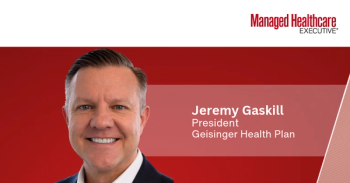
After more than 20 years at Humana, Jeremy Gaskill now leads nonprofit Geisinger Health Plan. The problems are the same, he says, the scale for solving them differs.
Jeremy Gaskill took the reins at the Geisinger Health Plan earlier this year after a long career at Humana. He discusses the similarities and differences between Geisinger and Humana and the advantages of a health plan that is part of a health system.
Part 1 of 2 parts
This transcript has been edited for clarity and length.
Jeremy Gaskill was named the president of Geisinger Health Plan in February 2026 after more than two decades of holding positions of increasing responsibility at Humana. The
You came over from Humana in February of this year. So what’s it like moving from a large publicly traded healthcare organization to a nonprofit like Geisinger?
I spent the last almost 22 years with Humana. I’ll start with the similarities first. There are a lot of similarities from a culture standpoint. Both organizations are large employers in midsize to smaller communities. The jobs and the impact of the employer are extremely important in the community, and as a result of that, you have environments where you have associates that have been with the company for 20 years, for 30 years. They met their spouse at the company. Their children work at the company. That culture, coming from Humana, where that culture was alive and well, and coming to a company like Geisinger with a similar culture, was a very easy transition.
I will also say that the challenges aren’t different. Whether you’re a large publicly traded company in the healthcare space or a midsize, private nonprofit company, it’s the same challenges: the same challenges in the Medicaid space, the same exact challenges in the Medicare Advantage space, and the same exact challenges in the commercial space.
There are some differences because of scale. That’s probably the thing that I’ve had to think about more and be more thoughtful in my approach as we think about addressing some of those challenges. The resources are different. The resources of a large publicly traded company to address some of those challenges are very different than those of a smaller midsize nonprofit that is privately held.
The missions are the same. Even at a large, publicly traded company, the work that we do is noble work. We’re ensuring that members and patients get the care that they need in the way that is appropriate in a patient-satisfied environment, with the ultimate north star being to keep them healthy and keep them well so they can live a long and healthy, prolonged life. In a nonprofit, though, it’s important for us to make a margin, because that margin then allows us to reinvest in the business, to improve benefits, and to improve outcomes for our members, but we don’t have Wall Street, where we need to deliver a 1% or 2% pretax margin, so it allows us to be able to invest those dollars back into our business to continue to strengthen our products and position us for growth and success long term.
You mentioned that you’re working at a different scale at Geisinger. Could you elaborate on that? You have about half a million folks in Geisinger Health Plan in various lines of business, compared with Humana, where it was millions.
At Geisinger we are much more diversified. We are in the commercial business. We are very strong in the Medicaid business. We are very strong in Medicare. We have opportunities to have what I would call controlled growth in the Medicare Advantage space. We will continue to have organic growth in our Medicare and Medicaid lines of business. That commercial environment is one that we’re thinking of how do we grow at a faster pace, but in a controlled but not reckless way. That diversification allows us a little bit more flexibility that I might not have had in my prior life because of the heavy leaning toward one line of business. Our ability to bring value to the providers because of the multiple lines of business allows us more flexibility. While we might not be as large as national payers, that does give us additional arrows in our quiver to be able to solve challenges and problems with our provider partners and create paths for success.
But the reality is, with the birth of AI [artificial intelligence] and the extremely fast-paced environment that it is creating, we just simply don’t have the resources to dump a bunch of money into an initiative to figure it out.
While we’re investing in scale with our resources in some of this emerging technology, we recognize that some of it’s not going to be successful. We need to be disciplined enough to accept failure, run from it, pivot and continue to move forward, but we have to be thoughtful about our resources because we don’t have as deep of pockets as some of the national providers. The logic in the strategy is the same. It’s just a different scale.
You’re a provider-owned health insurer. I think roughly a quarter of the health systems in the country have insurance arms like Geisinger does. So, what is the difference there in terms of how you operate? Does being owned by a health system give you some advantages?How do the beneficiaries benefit from a health system-owned health plan?
There is a lot of value to being owned by a clinical organization. The integration is a big piece of it. The aligned incentives is a big piece of it because of that integration. We can get rid of some of the busywork that goes on between payers and providers — the approvals, the backend edits and audits and things of that nature. It can speed up the approach to care of the patient.
The other thing that I think that it does quite a bit is align incentives. In my experience, [for] the providers that have been very successful in various lines of business, it is because there’s a recognition that the way to manage a Medicaid member is, often, different than the way you should manage a Medicare Advantage member or a Medicare member, and, in many situations, it is different than the way you should manage a commercial member.
Let’s just manage the patients all the same, regardless of what kind of type of program they’re in. I would suggest each of those programs dictate a different approach to what is best in managing that patient.
Ultimately, because of the integration and seeing the revenue dollars coming in from both sides, both the health plan and the provider side — the clinical side — there’s a recognition that there’s real value in keeping the member healthy, keeping the patient healthy, keeping them out of the hospital as appropriate, ensuring that they’re getting the right care at the right place, ensuring that they’re getting the right prescriptions in the right volume, ensuring that they’re seeing their primary care physician four to five times a year if they’re of a certain age or have certain ailments, and ensuring they’re seeing their specialists two to three times a year if that is what is needed. Because the ultimate result is, if the member is engaging with their primary care physicians and their specialists in addressing the comorbidities that they may have, that will ultimately keep them out of the ER [emergency room] and keep them out of an inpatient stay. That creates a very patient-satisfied environment, because I’ve never met a member that would like to be in the ER or in the hospital more than they need to be.
I would suggest that a provider organization that doesn’t have that lens through an integrated health system, it might incentivize a revenue-generating approach of, “We’re going to make money to get people in our system and have stuff done. That’s how we’re going to make money.”
about 1 hour ago
Jeremy Gaskill on moving from Humana to Geisinger Health Plan