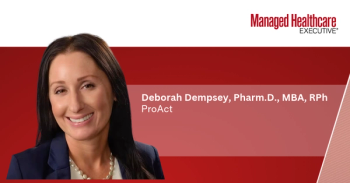
ProAct Chief Operating Offier Deborah Dempsey says plan sponsors still lack the data and visibility to know whether they were shorted on a 340B claim.
From her perch at Navitus, Crosson has become a prominent advocate on PBM transparency and prescription drug affordability issues, frequently speaking with policymakers, industry groups, and healthcare stakeholders about legislative reforms and regulatory trends.
Robyn Crosson, J.D., believes regulatory reform of the pharmacy benefits industry is an opportunity for the industry to evolve. A convergence of legislative and judicial actions is creating a pharmacy benefits industry that is focused on transparency and fiduciary responsibility. Pharmacy benefit managers (PBMs), pharmaceutical companies, plans and plan sponsors, hospitals and wholesalers, she says, have an opportunity to collaborate to do the right thing for patients and plan sponsors.
“Because amazing new treatments are transforming care, we all have to work together to find ways to afford them. That’s going to require innovation, honest discussions and a real focus on patients,” she says.
Crosson is a prominent advocate on PBM transparency and prescription drug affordability issues, frequently speaking with policymakers, industry groups, and healthcare stakeholders about legislative reforms and regulatory trends.
As vice president of government relations at Navitus Health Solutions’ parent company, LighthouseRx, she oversees relationships with state and federal policymakers, regulators, lobbyists and other healthcare stakeholders. Her work focuses on legislation and regulatory developments affecting pharmacy benefit managers, prescription drug pricing and the broader healthcare industry.
The pharmacy benefit industry is fast-moving and shapeshifting because of reforms from outside the industry and changes within. Crosson says her job is to make sure Navitus stays ahead of the changes while helping people afford and access care.
The PBM industry, she says, is embracing reform and transparency, but “it’s only one part of the entire ecosystem. Educating individuals about the entire ecosystem, incentives and disincentives, and their impact on cost, quality and outcomes is essential. The most important aspect is the human connection and meeting people where they are and at their level of understanding, their experience with the industry and any other personal issues that may impact their desire to work together.”
Crosson, 50, grew up in Indianapolis and currently lives there with her husband, Jarett Chaiken. Crosson and her husband have been married for 20 years and have been rescuing English mastiffs — a large, muscular dog breed — just as long. They met when they both worked for the Proskauer Rose law firm in Manhattan. Although Crosson and her husband have no dogs currently — their most recent dog, Aggie, passed away in January 2026 — they are working with rescues for a new dog.
“We’ve got a nice big home and a fenced yard, and all these dogs want to do is lie around and watch TV or be under our desks cuddling and slobbering and snoring. Oftentimes, they pop up in Zoom calls when I’m talking to legislators.”
Crosson’s career has taken her to Washington, D.C., New York, Chicago and now back to her hometown. But the one constant in Crosson’s career has been working within the insurance industry, including a stint as chief deputy commissioner of insurance for the state of Indiana under former Governor Mitchell Daniels.
It was a job at the age of 17 that led Crosson to her career in insurance. She was a claims customer service representative at Golden Rule Insurance in Indianapolis, reviewing claims with patients and helping physicians file appeals. Handling calls from patients asking why claims were denied or appeals were necessary, Crosson saw firsthand how law, economics and sociology intersect at the pharmacy counter. It was also there, she says, that she understood the need to meet people where they are and listen
to patients.
While an undergraduate, Crosson worked in the actuarial department of Anthem, now Elevance Health. She cites management’s encouragement and support of her curiosity about the industry. Crosson earned her undergraduate degree in business from Indiana University Kelley School of Business and her law degree at Indiana University’s Robert H. McKinney School of Law-Indianapolis.
Crosson joined Navitus Health Solutions in 2022. Navitus was founded in 2003 as a transparent PBM to provide clients with access to information about their contracts, financial transactions and claims data. Navitus is owned by SSM Health, a nonprofit, 24-hospital Catholic health system headquartered in St. Louis, and Costco Wholesale. Archimedes, a specialty drug management company, and Lumicera, a specialty drug pharmacy, are subsidiaries of LighthouseRx.
Crosson says Navitus appealed to her because of its focus on transparency and having the patient at the center of the company’s model. Crosson has become an advocate on PBM transparency and prescription drug affordability issues, frequently speaking with policymakers, industry groups, and healthcare stakeholders about legislative reforms and regulatory trends.
“On any given day I’m navigating healthcare law, economics, science and medical breakthroughs, and human behavior all at once,” she says. “The regulatory landscape is constantly shifting, and my job is to make sure our organization stays ahead of it while still delivering on our mission of helping people afford and access care.”
Crosson says the biggest challenges facing the PBM industry include high costs of specialty drugs and regulatory changes. Navitus’ own drug trend report shows that specialty drugs and the glucagon-like peptide 1 drugs continue to push drug spending higher. Prescription drug costs rose 8.4% for Navitus clients in 2025, reaching $120.08 per member per month, up from 7% the prior year. The specialty drug spending rose 11% last year, driven by a 13% increase in utilization.
Crosson recognizes the challenges of working in a sector often at the “center of one of the most contentious policy debates in American healthcare.” She views her role as helping stakeholders understand the entire ecosystem but with a focus on getting the right drug to the patient at a price they can afford. The traditional PBMs have built-in disincentives to disclose their relationships with other organizations and businesses, Crosson says. “That’s where transparency comes in: to highlight those disincentives,” she says. “When you don’t have transparency, people can’t really have an honest conversation about [costs] and where we want to go. Everybody is just protecting their little spot.”
There has been so much emphasis on negotiating the lowest reimbursement rates, but Crosson says managing the patient’s experience is just as important. What is needed instead, she says, is an effort among all stakeholders that includes honest conversations and a focus on patients. Clinical management, patient education and holistic programs are the newest areas of innovation, she says. “You’re starting to see organizations coming up and partnering with organizations to assist with clinical management and an interactive patient experience.”
The changing regulatory environment will continue to demand that organizations improve transparency across the entire industry. The Consolidated Appropriations Act, 2026 (CAA 2026) included new rules that are widely considered the most consequential PBM reform in recent history. Many of the rules don’t take full effect until 2029, but the industry is preparing for full rebate pass-throughs, added fiduciary responsibilities and a variety of measures designed to curb anticompetitive behavior and more disclosure of costs by PBMs to health plans and self-insured employers.
“After the passage of CAA 2026, we maintained and are advocating that transparency expand throughout the entire drug supply chain,” she says. That includes wholesalers and drug group purchasing organizations, and Navitus has developed documents making a case for this broader view. Crosson says Navitus has a firm policy about its independence from Lumicera and its owners.“Our goal is to be a partner,” she says. “Each one of our entities should stand on its own, adding value to the entire
upply chain.”
Crosson said Navitus clients already have access to much of the information required by the CAA 2026 but that smaller PBMs may not have the scale for the type of reporting and administrative burden that federal and state regulations require. The new rules could push some PBMs to consolidate. LucyRx and Abarca, two midsize pharmacy benefit managers, have announced plans to merge. Meeting the reporting requirements of CAA 2026 won’t be easy for many companies, she says. “The administrative burden of 50 different states with 50 different reporting schemes, sometimes two or three times a year, weighs heavier on a smaller organization than a larger one. But it’s not an easy lift for big companies either.”
about 1 month ago
PBMI Innovator, Joseph Savastaabout 1 month ago
PBMI Innovator Arpit Patel, Pharm.D.about 1 month ago
PBMI Innovator Robyn Crosson, J.D.about 1 month ago
PBMI Innovator Ashley Holzworth-Nash, Pharm.D.about 1 month ago
PBMI Innovator Raechele (Rae) McMahan, MBAabout 1 month ago
PBMI Innovator Patrick Gleason, Pharm.D.about 2 months ago
Ashley Holzworth-Nash, Pharm.D., Evernorthabout 2 months ago
Patrick Gleason, Pharm.D., Prime Therapeuticsabout 2 months ago
Arpit Patel, Pharm.D., MedImpactabout 2 months ago
Raechele (Rae) McMahan, MBA, Prescryptive Health