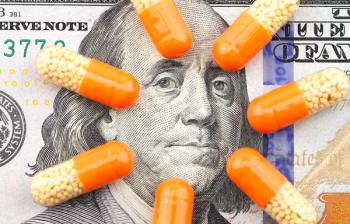
The trade group argues CMS exceeded its authority with GLOBE, a Medicare Part B model tying drug rebates to prices in 19 other countries.
A recent analysis shows that most products subject to price reduction under the Inflation Reduction Act have achieved substantial returns on investment by the time of negotiations.
Medicare’s drug price negotiations will have just a small impact on the profit of pharmaceutical companies and likely won’t negatively affect innovation, according to a new study from researchers at Bentley University's Center for Integration of Science and Industry.
Researchers found that revenues from these negotiated drugs account for just 10% of the companies' total revenue and that these firms remain highly profitable despite price reductions for Medicare patients and are unlikely to impact future investment in innovation. The study was
“These companies, on average, are not dependent upon these particular drugs for their operating capital,” Fred Ledley, M.D., one of the authors of the study and director of the Center for Integration of Science and Industry at Bentley University. “The amount generated from these drugs is less than their profit margins, so they don’t have to reduce their operations.”
Ledley pointed out that profits from the drugs before price negotiations were three to four times higher than the average historical cost of drug development.
Additionally, the drugs subject to negotiation are typically nine to 12 years past their initial approval, meaning companies have had nearly a decade to recoup development costs and generate profits. “The likelihood is that when these prices are reduced, they’ve already made in excess of what's called a normal return on investment,” Ledley said in an interview.
The analysis builds on previous research of Ledley’s into the economics of pharmaceutical innovation. In the new analysis, they wanted to understand how each company would be impacted by the reduced pricing and what that would mean for each company’s research.
“At this point there were enough companies, enough drugs and enough data on how much those drugs were selling in the United States and also globally to ask how much of their revenue, how much of their profit, and how much of their operational costs are being offset by revenues from those drugs,” Ledley said.
They examined 11 publicly traded pharmaceutical companies responsible for 21 of the drugs subject to price negotiations under the Inflation Reduction Act in 2024 or 2025 relative to comparable companies in the S&P 500. From 2019 to 2023, together these companies reported $2.5 trillion, including $260.8 billion in U.S. sales from IRA drugs.
Researchers accessed corporate financial data from Compustat. Product-specific revenue, as well as rebates and chargebacks, was taken from corporate 10-K filings using ChatGPT 4.0 and confirmed by the researchers. They estimated the margins on sales of drugs as the fraction of annual product revenue multiplied by the operating margin plus R&D of the operator in that fiscal year. Then the margins were discounted to the year of first FDA approval with a 10.5% discount rate. They used estimated average development costs that have been reported by previous researchers.
Ledley and his colleagues found that the estimated margins were 2.3 to 4.4 times higher than the reported average industry investment in new drugs and normal returns on investment. “The likelihood is that when these prices are reduced, they’ve already made in excess of [what’s considered] a normal return on investment,” Ledley said.
He pointed out, however, that the impact varies by company. Some firms have only one drug subject to negotiation, while Bristol Myers Squibb, for example, faces price cuts on multiple products. This is especially true for companies that are nearing the end of patent protection and are facing competition from generics or biosimilars.
As more drugs enter the negotiation process in coming years, Ledley said his team will continue monitoring financial impacts across the pharmaceutical sector.
The research was funded by the National Biomedical Research Foundation through grants to Bentley University.