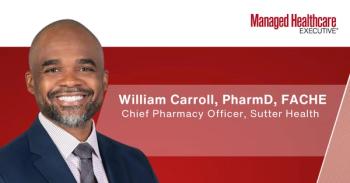
Will Carroll, Pharm.D., of Sutter Health says future pharmacy leaders need business, finance and AI skills, and health systems need real sponsorship.
David Chen, Pharm.D., explores how formulary strategy and biosimilar adoption are reshaping affordability across health systems.
As biosimilar competition grows and PBM reform increases price transparency, health systems are looking for ways to turn lower drug costs into real savings for patients. Kaiser Permanente's total-value approach to formulary management aims to do just that, directing savings back into the system and to members rather than relying on rebate-driven contracting, according to David Chen, Pharm.D., executive director of Formulary and Drug Use Management at Kaiser Permanente.
In this discussion, Chen discusses how his team is balancing innovation and financial sustainability and expanding biosimilar access.
This conversation has been edited for length and clarity.
MHE: To begin, would you briefly introduce yourself and provide an overview of your role at Kaiser Permanente?
Chen: I'm David Chen. I am the executive director with the Kaiser Permanente National Pharmacy, leading the formulary and drug utilization management teams. My work focuses on delivering high-value, affordable and evidence-based medication use in our system. That is a unique opportunity within the organization to keep us aligned, working with our physicians, our clinicians and our operational leaders to make good formulary and utilization decisions.
MHE: Payers and pharmacy benefit managers (PBMs) play an important role in how patients access medications. How does Kaiser Permanente think about balancing access to innovative therapies with long-term financial sustainability?
Chen: Balancing innovation and financial sustainability aren’t competing priorities with us. They're definitely interdependent, given the approach that we take is a clinician-led, vigorous review of our materials and our evidence. We see that if we align our contracting strategies and preferred therapies, we can remain financially stable but also provide opportunities to innovate with those dollars that are saved. It's a total value, and they come back to our own system for us to use to improve other aspects of our business, including innovation.
MHE: PBM coverage decisions and formulary design can affect biosimilar access for patients. From your perspective, how have biosimilars benefited Kaiser Permenente’s patients?
Chen: The biosimilar market is very similar to the generic market. It provides
great drugs at an extremely affordable price point. It's meant to improve access to the number of medications available. It also helps to improve competition within the market.
I think that access to more affordable care that is equally good quality allows the KP model to shine. We've been trying to share how to improve the access to biosimilars by optimizing systems and optimizing the approach that people can take to introduce more. The PBM models and the rebates don't favor biosimilars compared to the branded products. We don't have that issue at KP. We are looking for a total value, not a rebate-driven model, so everything that we're able to save goes directly to our bottom line and also to the members in the cost that they have to share in getting their medications.
MHE: PBM reform continues to be an important topic across healthcare. How do you think recent reform efforts would influence biosimilar adoption in the United States?
Chen: PBM reform is a hot topic. I think it makes the drug pricing transparency more apparent. The acquisition cost to the organization as well as to our patients means the most, and passing off that savings to them is the cornerstone of why we have our business model our way, and I think the PBM reform will help us move in that direction.
MHE: Are there any additional policy changes you believe would strengthen the biosimilar market? For example, the elimination of the comparative advocacy study for new biosimilar approvals?
Chen: I think the direction the market is taking as well as the policy around studies and comparative efficacy trials is speeding up the process in terms of ways we can access and utilize biosimilars more rapidly. Previously, clinical trials have had elements that require every large biosimilar to do a phase three clinical trial. It made it difficult for some generic vendors to come to market. With more manufacturers and broader competition, there are potentially higher uptake and incentives for that. The intent is to look at lower costs with clinically equivalent options. Anything that supports that would be great.
MHE: As you look ahead to your first health system executive summit, what is it about this gathering that stood out to you, and what are you hoping to take back to Kaiser Permanente from the conversation and the connections you expect to have?
Chen: I am a new executive at Kaiser Permanente. Like I mentioned before, I don't have a lot of exposure or experience outside of my organization. I'm looking forward to meeting my peers across the industry, casual conversations with them, understanding the pain points they may have, and some of the solutions that they're going to have to work through.
Also, to understand how we can potentially leverage other ways of thinking to expand our organizations and tackle this broader health care affordability issue. I'm looking forward to coming and participating.