Hispanic HIV incidence rose 16.8% in antisanctuary counties after the 2018 public charge announcement, relative to baseline counties, a new study found.
In this conversation, Kirk Grisham, M.P.H., and Vishakh Unnikrishnan, M.P.H., both from the Center for HIV and Infectious Disease Policy at the O’Neill Institute, explain how federal funding cuts are destabilizing state HIV programs and why state leadership and political will now largely determine whether people keep access to HIV prevention and care.
Amid ongoing federal budget uncertainty and the fallout from major safety-net rollbacks, recent changes to HIV support programs are underscoring growing strain across the U.S. public health system.
Most recently, the Florida Department of Health reduced eligibility for its AIDS Drug Assistance Program, though a temporary stopgap measure was quickly enacted to extend coverage for current enrollees through the end of June.
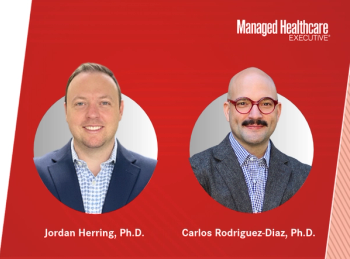
Experts from the O’Neill Institute for National and Global Health Law, located at the Georgetown University Law Center in Washington D.C., warn that HIV programs are increasingly serving as a bellwether for broader systemic challenges. Kirk Grisham, M.P.H., and Vishakh Unnikrishnan, M.P.H., both program managers at the Center for HIV and Infectious Disease Policy at the O’Neill Institute, explore these issues in their recent brief,
They recently sat down with Managed Healthcare Executive to discuss the importance of federal funding at the state level.
This interview has been edited for length and clarity
MHE: How have disruptions and delays in federal grant awards, mid-year cancellations and reductions in funding exacerbated pressure on state and local health departments?
Grisham: What we've seen over the past almost year and a half now is widespread disruption. HIV prevention efforts are largely funded at the federal level but carried out by state and local health departments. So, when there are cancelations of grants or rescissions, funds are withheld, and it causes a large-scale disruption to the HIV prevention activities at local and state levels. This means less testing, less surveillance and less engagement with communities. It’s also important to note that we are also seeing less HIV surveillance activity at the CDC, so it’s a double-edged sword.
Basically, the cuts to Medicaid, the implementation of work requirements, the lack of Medicaid expansion in states, and the non-renewal or non-extension of enhanced premium tax credits created a perfect storm for a lot of states, particularly states without Medicaid expansion, and in red states that have less revenue generation because of their tax systems.
Unnikrishnan: The HIV workforce is also impacted. A lot of the community members who have gone to HIV test centers can no longer find the care that they need there.
MHE: Your brief states that the FY 2026 HHS budget signed into law by the president largely flat-funds core HIV programs. How so?
Grisham: Flat funding is a problem because of basic things like inflation.
If we're doing our job with HIV, we're going to be increasing the number of people who are on PrEP. We're going to be increasing the number of people who are on treatment and so those costs are going to go up.
When you have something funded and you're not increasing the capacity of the system to meet our public health goals, we see these challenges.
Unnikrishnan: Spillover effects from SNAP cuts and Medicaid work requirements being implemented will have more people depending on the federal budget that's being flat funded. Even with these new forms of long-acting PrEP that can drastically reduce HIV transmission, there seems to be more of a flat funding of programs, which could obviously severely limit what is possible.
MHE: In your brief, you said that state leadership is more important now than ever. Can you elaborate on that?
Grisham: Along with the disruptions, there's also been a hollowing out of the public health infrastructure at the federal level. What we're looking at now is the need for state and local health departments to step up, both in terms of leadership and in terms of financial commitments. If you've been following what's going on in Florida, they had an ADAP budget crisis, where there were a lot of projected shortfalls, and they initially responded by cutting eligibility. Just recently, in the Florida state government, they passed a temporary stopgap of roughly $30 million to fund ADAP. So, this is important for a short-term response, but we need a longer-term response.
MHE: What can states do to mitigate federal cutbacks?
Grisham: There are basic things, like using rainy day funds, raising taxes on high income, and closing corporate tax loopholes and avoidance. You know, tax on stocks and investments. These are options that are available. It's just whether there's political will.
Another way to mitigate federal cutbacks is to align ADAP formularies with Medicaid formularies. We're not going to argue for prior authorization, but there's tinkering that can be done at the administrative level with how Ryan White handles their kind of approval of medications and insurance.
There are also measures that can reduce the short-term spending. For example, implementing maximum prescription number caps. I want to be cautious about saying “prior authorization,” because in a lot of instances, it's a cost containment tool, and it's where payers are making medical decisions rather than financial ones, and so we want to avoid that.
Unnikrishnan: Also, you have states like Wisconsin and Wyoming increasing funds for ADAP, so there is a bit of a choice that they have. It's not mandatory for them to reduce ADAP funding. There isn't a reason to cut funding because most of the federal funding has stayed flat.
The main objective is protecting the most vulnerable, and because a lot of case managers and everyone in between know who the most vulnerable are, the states know who the most vulnerable are. So, take that information and implement it.
MHE: If there was one thing you'd like somebody to take away from the conversation and from this report today, what would it be, and why?
Grisham: I think the most important takeaway is that, looking at Florida, it's a win in terms of their response to address the gap in funding. I would say that that is a result of the organizing and advocacy efforts among the HIV community in Florida. We need to see that in every state.
Unnikrishnan: I would say that it is the fact that some states are doing something already. These strategies have been adopted by some states, and some of them are good. As Kirk mentioned, prior authorization is not something we want to push for. We want to keep people in the care system and continue to receive care and not the other way around. For advocates, for people who are talking to policymakers, I think there is some evidence that this is possible, and political will is the underlying factor as to whether states are taking steps to ensure people get access and continue to have access to care.