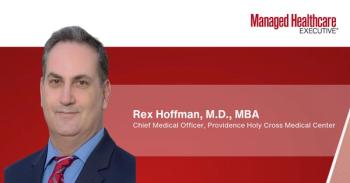
Rex Hoffman, M.D., MBA, says physician shortages and burnout are the most underestimated pressures on health system.
Lorece Shaw, Pharm.D., is director of clinical account consulting at Capital Rx, a pharmacy benefit and management company.
I am a Houston native. My interest in healthcare started early through my experience at the DeBakey High School for Health Professions. I went on to earn my undergraduate degree in composite science and pedagogy from Houston Christian University, graduating cum laude, before completing a Pharm.D. at Texas Southern University.
I began my career in a compounding pharmacy, which grounded me in patient-centered care and clinical problem-solving. I started at Capital Rx in the prior authorization department after having been in the PBM [pharmacy benefit manager] space for over five years. At Capital Rx, I’ve had the opportunity to grow and take on increasing responsibility, ultimately advancing to senior director and overseeing the full end-to-end prior authorization process. That experience allowed me to build deep expertise across clinical review, operations and workflow management at scale. I recently transitioned into a client-facing role, where I now apply that operational and clinical background to help clients navigate and optimize their pharmacy benefits.
A defining turning point in my career was my progression within Capital Rx, beginning in prior authorization and ultimately leading the end-to-end function. While that role built a strong operational and clinical foundation, the start-up environment also gave me meaningful exposure beyond prior authorization across areas such as formulary, benefit design and clinical programs.
That cross-functional experience shifted my perspective from managing a single function to understanding how multiple parts of the organization come together to deliver value. Transitioning from that operational leadership role into a client-facing position was a natural next step, allowing me to pair that breadth of understanding with strategic partnership. It continues to shape how I approach my work today by bringing both detailed, hands-on knowledge and a holistic view of the business to support clients effectively.
One of the biggest day-to-day challenges in my role is translating complex clinical and operational concepts into clear, meaningful insights for clients. Each organization has unique goals and priorities, so aligning those needs while maintaining consistency with best practices requires thoughtful communication and adaptability. Managing multiple stakeholders and evolving priorities also demands strong organization and a proactive approach.
We are incorporating AI [artificial intelligence] into prior authorization workflows by automating administrative and repetitive tasks, such as data intake and documentation. This allows pharmacists to spend more time on clinical review and decision-making. From a client perspective, the result is improved efficiency, faster turnaround times and a more consistent experience for members.
Our top priority this year and next is advancing Judi Health as a fully integrated platform for both medical and pharmacy claims processing. The goal is to create a more seamless experience for clients by improving transparency, reducing fragmentation, and enabling more coordinated insights across medical and pharmacy data.
One book I would recommend is “The Immortal Life of Henrietta Lacks.” It highlights the human side of medical advancement by telling the story behind one of the most important scientific contributions in modern medicine.
For anyone working in healthcare, it serves as a powerful reminder of the ethical responsibilities we carry, particularly around consent, equity and patient trust. It also underscores how systemic issues can shape patient experiences, which is important context when making decisions that impact care at scale.
U.S. healthcare costs are driven by a combination of factors, including administrative complexity, fragmented systems, and high prices for services and medications. Addressing these challenges will require a focus on greater transparency, alignment of incentives across stakeholders, and investment in technologies and models that reduce inefficiencies. Progress will come from practical, collaborative solutions that improve access, affordability and outcomes for patients.
Outside of work, I am focused on prioritizing my health and overall well-being. As someone who works remotely and did not grow up particularly athletic, I am intentionally building more consistent habits around movement and exercise. My goal is to create a sustainable routine that supports both my physical health and long-term balance.