
Opinion|Videos|November 20, 2026
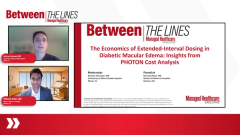
DME Cost Analysis Results: Fewer Injections Drive Lower Total Costs
Author(s)Nicolas Yannuzzi, MD, Nimesh Patel, MD
Despite a higher price per dose, the extended-interval regimens produced lower total spending over 96 weeks. The panel reviews cost results and explains why injection visit count drove the differences.
Advertisement
Episodes in this series
In "DME Cost Analysis Results: Fewer Injections Drive Lower Total Costs," the panel presents the 96-week cost findings and what drove them.
Dr. Yannuzzi presents the 96-week results of the cost analysis. On a per-dose basis, the 2 mg dose is significantly less costly at about $1,900, compared with about $2,600 for the 8 mg injection. The 8 mg Q12 and Q16 arms had more monitoring visits but far fewer injections, at about 9 and 8 respectively versus 14 with the 2 mg dose.
Those differences shaped total spending. Mean total cost over 96 weeks was about $41,000 for 2 mg every 8 weeks, $37,000 for 8 mg every 12 weeks, and $32,000 for 8 mg every 16 weeks. Dr. Yannuzzi highlights the key messages: the 8 mg Q16 regimen had the lowest mean total cost, and the savings came primarily from fewer injections despite the higher per-dose price. Across 10,000 Monte Carlo simulations, Q16 was the least costly of the three arms.
He then shows a second view that places direct costs next to total costs. Both direct costs and total costs, which add the indirect items Dr. Patel raised earlier, were lower with 8 mg than with 2 mg. The gap was widest in the Q16 arm.
Dr. Yannuzzi concludes that the cost differences were driven almost entirely by injection visit count. He asks Dr. Patel whether that reflects the cost structure in his own clinic. Dr. Patel agrees and says it matches the national picture. Reimbursements for imaging and for the injection procedure itself are declining. The medication is the largest driver of cost. Limiting the number of injections therefore improves overall costs, even when the agent has a higher price.
Up next, in "DME Payer Perspective: Weighing Upfront Drug Costs Against Long-Term Savings," Dr. Patel explains how payers should interpret these findings.
Advertisement
Related to this article

A Centene OB-GYN and an AAFP family physician explain how health plans, primary care and policy can help close rural maternity care gaps.

Nelkarmi gives ALK-positive lung cancer patients a new option after first-line therapy stops working
The FDA granted accelerated approval to GSK's Nelkarmi for previously treated ALK-positive NSCLC, the company's second lung cancer approval this year.

A pooled review of 40 studies tied type 2 diabetes to a 53% higher Alzheimer’s risk, with incidence more than doubling when clinicians made the diagnosis.
Lockton's Sarah Klein says employers are already asking hard questions about PBM transparency, even though many of the new rules have not taken effect.

WIC participation is estimated at only 44% of eligible Medicaid enrollees in 2023, and just 15% of pregnant Medicaid enrollees. Health plans can help close that gap, but only if their referrals are tracked through enrollment.

Heidi Overton ran into opposition from Republican senators concerned about her role in setting White House vaccine policy.
In more than 256,000 adults with prediabetes and obesity, GLP-1s were linked to better blood sugar and heart outcomes than metformin, according to a study presented at the American Heart Association (AHA) Scientific Sessions 2026.

Takeda’s Orzeyful, the first orexin agonist for narcolepsy type 1, is now available in the U.S. at a whole acquisition list price of $16,500 per 60-tablet bottle.
Advertisement
Advertisement
Trending on Managed Healthcare Executive
1
Closing rural maternity care gaps starts close to home, Centene and AAFP leaders say
2
Type 2 diabetes associated with 53% higher Alzheimer’s risk, with claims data likely undercounting cases, review shows
3
Takeda launches Orzeyful, first orexin agonist for narcolepsy type 1
4
Quick Q&A: Sarah Klein on scrutinizing PBM contracts
5