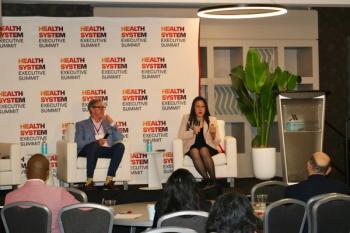
As the pharmacist pipeline tightens, leaders from UC Davis Health, UCSF Health, and Sutter Health say financial sustainability now depends as much on capacity as on cost.
A study participant in the trial of daraxonrasib felt like he was part of something special, says UT MD Anderson's Shubham Pant, "and he is."
Historically, positive results from phase 1 trials have often flamed out and had to be discounted by 60%, according to Shubham Pant, M.D., M.B.B.S. Pant is cautiously optimistic about a phase 3 trial investigating daraxonrasib, but he emphasized caution.
Pant, a professor of gastrointestinal medical oncology at The University of Texas MD Anderson Cancer Center in Houston, said he was fairly confident that an open-label, phase 3 trial comparing daraxonrasib, a once-a-day pill, versus one of four chemotherapy options for patients with pancreatic cancer would come out in daraxonrasib’s favor.
“…In pancreatic cancer, you never know, because, 20 negative trials later, it can burn anybody. I'm an optimistic person by nature, but it can burn somebody,” he said.
Results of the RASolute 302 study of daraxonrasib were presented Sunday at the plenary session of the 2026 American Society of Clinical Oncology Annual Meeting in Chicago. The results, which garnered the most attention of any findings presented at the meeting, showed that daraxonrasib exceeded chemotherapy regimens by a wide margin on the primary end points of overall survival and progression-free survival. The study, sponsored by Revolution Medicines, the maker of daraxonrasib, showed that the overall survival among the 228 participants randomly assigned to daraxonrasib was 13.2 months, compared with 6.6 months among the 231 participants who received chemotherapy. The study participants had all been previously treated, and most had an RAS G12 mutation.
Researchers and clinicians are heralding daraxonrasib as a major advance in the treatment of pancreatic cancer, which has remained one of the deadliest cancers in the U.S., with a five-year survival rate of just 13.7%. In comparison, the five-year survival rate of patients with lung and bronchus cancer is 29.5%, and the five-year survival rate for patients with breast cancer is approximately 90%.
The results for the phase 3 trial didn’t come out of the blue. They were preceded by findings from a phase 1 trial that also indicated an overall survival rate of approximately 13.1 months. The RASolute 302 results were remarkable, Pant said, because the overall survival rates held up even though historically phase 1 results have to be discounted by 60%.
Pant said he shared the positive results with a patient who is enrolled in the trial. “We just had a great moment. He just felt he was part of something special, and he is,” Pant said.