Rex Hoffman, M.D., MBA, says physician shortages and burnout are the most underestimated pressures on health system.
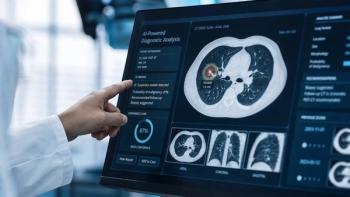
The AI-powered imaging technology quantifies the extent of fibrosis on CT scans and also measures other features, such as ground-glass opacification.
Brainomix, an innovator in AI-powered imaging for lung fibrosis and stroke, has developed an AI-based technology that can quantify the extent of interstitial lung disease and pulmonary fibrosis on routinely performed CT scans, the company announced at the American College of Chest Physicians’
The U.K. company presented findings that its 360 e-Lung technology could potentially speed up the diagnosis of progressive pulmonary fibrosis by nearly two years in more than half of the patients evaluated.
“Providing accurate and objective quantification of pulmonary fibrosis on CT means that when serial CT scans are compared side by side with e-Lung, the platform can identify imaging-based progression that cannot be easily identified by a radiologist,” Jeff Wyrtzen, chief marketing and business development officer for Brainomix, told MHE.
Importantly, e-Lung is FDA cleared and is already being used by clinical teams in the United States to support the management of patients with interstitial lung disease.
“When we validated the technology in a recent U.S.-wide multicenter collaborative study between the University of Chicago, Weill Cornell Medicine and the University of Alabama, we discovered that e-Lung could identify CT features of progressive pulmonary fibrosis as much as approximately two years earlier than was previously possible,” Wyrtzen said.
e-Lung quantifies the extent of fibrosis on CT scans and also measures other features such as ground-glass opacification, which can be a surrogate for inflammatory or potentially reversible lung disease. The platform produces a Total Disease Extent score that quantifies all the interstitial lung disease observed on a CT scan.
“We have shown that a rise in the Total Disease Extent score of as little as 1.5% on serial CT scans is associated with poor long-term outcomes, including a higher risk of mortality, showing that this small change—which is likely imperceptible to a radiologist—is clinically meaningful,” Wyrtzen said. “e-Lung also produces the weighted reticulovascular score, which has been shown in several cohorts to predict the likelihood of future lung function decline and mortality from a baseline CT scan. This can be used to predict clinical outcomes in routine practice and for patients recruited to clinical trials.”
There is a strong body of evidence indicating that the earlier identification of progressive pulmonary fibrosis is closely associated with better outcomes, he noted.
“Progressive pulmonary fibrosis is irreversible and once lung function is lost, it cannot be regained,” Wyrtzen said. “Considering patients for lung-preserving drugs such as antifibrotic therapy at the earliest possible time presents the best opportunity for maintaining a patient’s quality of life, independence and eventually life expectancy.”
One feature of e-Lung is that the outputs are visually accessible to patients, with color overlays indicating areas of lung disease.
“I think that for us to truly move the needle, we need to bring patients with us on the journey, and providing patients with the opportunity to understand their disease and possible progression with their care providers ensures more meaningful management-based discussions,” Wyrtzen said.
Brainomix has a long track record of integrating novel technology into clinical care. The company pioneered artificial intelligence tools for acute stroke management as a spinout from the University of Oxford and now supports hundreds of hospitals across more than 20 countries. Challenges still exist, the company acknowledged.
“We have worked collaboratively with early-adopting U.S. healthcare providers to develop solutions for seamless integration with radiology workflow, IT integration, multidisciplinary team assessment and networking of geographically diverse teams,” Wyrtzen said.
Looking ahead, the company expects e-Lung to play an increasing role in the care of patients with interstitial lung disease, including in drug development.
“One exciting area is the opportunity to use e-Lung to speed the approval of novel therapies,” Wyrtzen said. “Brainomix works closely with pharmaceutical partners to do so. For example, the technology has been shown to identify an antifibrotic treatment effect in a retrospective evaluation of the pivotal INBUILD trial of nintedanib for progressive pulmonary fibrosis. In the upcoming Phase 3b DROP-FPF study of nerandomilast [sold under the brand name Jascayd] in familial interstitial lung abnormality, e-Lung will be the first quantitative CT tool to be used as part of a primary end point in a Phase 3 interstitial lung disease clinical trial.”
As part of its U.S. expansion, Brainomix plans to collect data on how e-Lung affects patient outcomes, radiologist confidence and physician treatment decision-making.