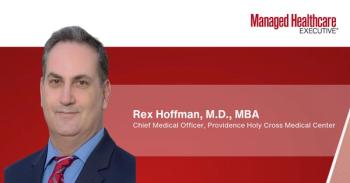
Rex Hoffman, M.D., MBA, says physician shortages and burnout are the most underestimated pressures on health system.
Alyana Samai, M.P.H., is corporate vice president, neuroscience and musculoskeletal services, at LCMC Health, an eight-hospital, New Orleans-based nonprofit health system.
I grew up in Coral Springs, Florida, where my early life was profoundly shaped by my family’s experience caring for my older sister, who became medically fragile after contracting meningitis as an infant. Though my sister lived with significant limitations, her enduring joy and unique ability to connect with others left a lasting impression. Witnessing both the challenges and the humanity of long-term caregiving gave me a deeply personal understanding of healthcare, one that continues to guide my commitment to compassionate, patient-centered systems of care.
I earned my bachelor’s degree in health science from the University of Florida, followed by a Master of Public Health in epidemiology from the Tulane University School of Public Health and Tropical Medicine. I began my career in neuroscience in 2013, focusing on stroke research, and have an extensive body of published work, including articles in Stroke and JAMA Neurology. Driven by a passion for improving systems of care, I transitioned into healthcare leadership in 2016 as stroke program coordinator at West Jefferson Medical Center (WJMC), part of LCMC Health. Under my leadership, WJMC achieved comprehensive stroke certification from The Joint Commission, the highest level of stroke certification.
In my current role, I have led the creation of a systemwide neuroscience service line at LCMC Health and oversee an extensive telestroke network spanning Louisiana and Mississippi. I have also played a key role in guiding multiple facilities, including East Jefferson General Hospital and University Medical Center New Orleans, to achieve comprehensive stroke center designation. Most recently, I extended my service line development work to include the organization’s musculoskeletal program.
I have served with the New Orleans American Heart Association as board president from 2023 to 2025 and most recently as chair of the 2026 New Orleans Heart Ball.
I initially entered college with a strong belief that I would not pursue a career in healthcare. Having grown up with a front row seat to my sister’s medically complex life, I associated healthcare primarily with hospitals and difficult personal experiences, and I was intent on stepping away from that environment.
After my freshman year, however, I began to reconsider and realized that turning away from healthcare altogether would be a profound missed opportunity to meaningfully honor the experiences my family had lived through. I began to see that I might actually be uniquely positioned to contribute to the field. Initially, I thought that would be as a physician.
My trajectory shifted again when I was accepted into the College of Public Health and Health Professions at the University of Florida and met Sarah McKune, [an associate professor] who became a formative influence. She invited me to her home to discuss my goals and was the first person to suggest the epidemiology path. She was able to identify that my experiences, particularly the unanswered questions surrounding the cause of my sister’s illness, had created a natural curiosity for understanding causation and the why behind health outcomes. She encouraged me to consider epidemiology as a field that aligned with that investigative drive. That conversation ultimately led me to pursue my M.P.H. in epidemiology, and it set the foundation for the career path I continue to follow today.
The most interesting part of healthcare also happens to be, in my opinion, the biggest challenge: The landscape is always changing. I love that I walk into work and no two days are the same, but it also means that we as healthcare leaders must always be on our proverbial toes — ever vigilant for the next advancement that will change lives. More importantly, we must then find ways to act quickly and implement these innovations effectively so that patients are able to access them, often in areas with variable resources.
Being in healthcare at the dawn of the AI [artificial intelligence] boom feels reminiscent of when the internet first emerged. It is a clear pivotal moment in how healthcare will be delivered. The use cases seem endless, as does the potential. Our challenge in healthcare is ensuring the right balance between enhancing care delivery, supporting our providers and safeguarding patient privacy. To that end, we have seen a significant surge in healthcare-specific AI tools and have already begun incorporating them into areas such as stroke imaging in radiology and rapid EEG [electroencephalogram] monitoring, where algorithms can quickly identify critical findings and alert physicians in real time.
This year and next, our top priority is to create a truly seamless, patient-centered experience where individuals can access the right care at the right time across a fully connected system. At the same time, we are strengthening coordination across services and expanding access to high-quality, specialized care so that patients and families across our region can more easily receive the care they need close to home.
“The Diving Bell and the Butterfly.” The movie crystallizes the humanity of healthcare: the vulnerability of the patient experience, the universally human desire for respect and autonomy, and the compassion required of healthcare providers when they truly put the patient at the center of care. I also recommend “The Power of TED: The Empowerment Dynamic.”The book sheds light on patterns that people commonly fall into while also providing a road map for shifting those mindsets to become more effective and fulfilled, both personally and professionally. “The One Minute Manager”is a great resource for anyone in a leadership role, and it emphasizes a point that is often overlooked in many leadership tools: Management is not, and should not be, the same from person to person.
The reality is that there is no single driver or single solution. The cost of healthcare in the U.S. is driven by a combination of factors, including but certainly not limited to the complexity of delivering advanced care, the structure of payment and reimbursement across the continuum, and the investment required to sustain innovation in treatments and technology. There are multiple stakeholders — including providers, payers and regulators — and each significantly influences these dynamics.
Meaningful progress will require better alignment of incentives across the system, reducing unnecessary complexity and focusing on value so that patients can access high-quality care in a more affordable and sustainable way.
My personal philosophy is that if healthcare as a whole can truly keep the patient at the center of everything we do, the outcomes will follow.
In 2023, I could not run for more than 30 seconds at a time, despite being otherwise in good shape. Running was never something that came naturally to me, but one day, I decided I wanted to change that and began training for my first 5K. Since then, it has evolved into a much larger personal goal.
This year, I am training to run a half-marathon in Egypt in December and to complete my first full marathon in Croatia next year.
For me, these goals are about challenging myself in new ways and experiencing incredible places along the way, crossing a few things off my bucket list because, ultimately, life is short and health is precious.