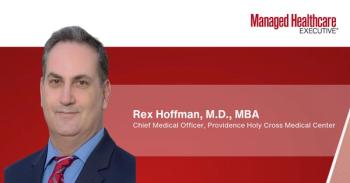
Rex Hoffman, M.D., MBA, says physician shortages and burnout are the most underestimated pressures on health system.
In this interview, George Eastwood, Executive Director of the Emily Whitehead Foundation and CAR T Vision steering committee member discusses barriers and strategies for expanding access to CAR T-cell therapy.
Chimeric antigen receptor (CAR) T-cell therapy is a treatment for blood cancer that adds a lab made gene to a patient's T-cells, which are white blood cells in the immune system that fight cancer. This change allows the T-cells to more effectively detect and kill cancer cells. In some cases, this process can cure blood cancer, such as in the case of Emily Whitehead, who was the first child to receive CAR T-cell therapy, which cured her acute lymphoblastic leukemia. There are currently
George Eastwood, who is the Executive Director of the
Eastwood is also a member of the CAR T Vision Steering Committee, which plans to double the number of eligible patients receiving CAR T-cell therapy by 2030, as well as a board member of the Alliance for Regenerative Medicine.
Eastwood is attending the 67th American Society of Hematology (ASH) Annual Meeting being held in Orlando from December 6 – 9.
This interview has been edited for length and clarity.
MHE: What can the attendees of the 2025 ASH Annual Meeting this week expect to hear from the steering committee?
Eastwood: I believe this is the first in-person convening of the entire steering committee. I think on a micro level, all of the conversations that we have at the conference will build that momentum and connection to all of these challenges that we all know so well.
Getting together, gathering thoughts and convening the larger groups is the goal of the CAR T Vision’s connection this week. There are so many exciting sessions around CAR T advancements, beyond even the current indication.
MHE: Why is there so much buzz around CAR T-cell therapy?
Eastwood: CAR T-cell therapy fundamentally changes the way we treat patients, especially in aggressive blood cancers and in those who have relapsed or have exhausted other options; this truly is their only hope. We're hoping that we can move this therapy further up the treatment line and deliver it to more patients at scale.
MHE: What are some barriers that patients face to receiving CAR T-cell therapy?
Eastwood: There are many barriers, including general awareness, at the patient side, on the referral provider side and generally throughout the world. We often talk about cures, but not often enough about the ones that are in existence now. We're seeing great success with awareness and referrals from community physicians into the academic centers that pioneered these treatments.
On the other side, we're looking at capacity and logistical issues, which, from my former life in collections and manufacturing, were the only bottlenecks we thought of leading to the administrative side and the financial hurdles.
MHE: How can some of these barriers be addressed?
Eastwood: A lot of it is listening at the very beginning, and then we move to action and start delivering. We are now eight years post approval. The infrastructure has grown and so has the need to bring together the entire system.
CAR T Vision does that through a large steering committee with diverse stakeholders, considering all those barriers we mentioned, looking at ways to increase awareness, and optimizing capacity and logistics. Most importantly, it's bringing in the full conversation around payment payer models to educate everyone, even on the patient side.
MHE: By 2030 CAR T Vision aims to double the proportion of patients treated with CAR T-cell therapy. How many patients are currently treated with CAR T-cell therapy?
Eastwood: Since 2017, we've treated about 50,000 patients. To double that, we'd need to hit 100,000 which, while it is aggressive, is still quite doable considering the number of patients that aren't getting treated.
As a recent member of the steering committee, this is something we are looking to tackle as an entire organization.
MHE: How will success be measured?
Eastwood: I think very easily if we look at doubling capacity, but it’s not always easy to measure the steps that need to be taken. Getting together as a group and doubling the number of patients is a great, ambitious goal, but there are so many levers, from the policy side to the payer side to the patient side. We need to agree to those KPIs and measurements together as a team, while keeping the patient in mind.
That 50,000 to 100,000 by 2030—that will be the definition, but there'll be many other factors that we need to track in advance of that, instead of just measuring the number right now and in five years.
MHE: In addition to your role at the Emily Whitehead Foundation, you also serve on the board of directors for the Alliance for Regenerative Medicine and as a CAR T Vision Steering Committee member. How do your roles work together to further the goal of accessible CAR T treatment?
Eastwood: It can be hard to see all these interconnected pieces on the systems level. Not everyone can understand the challenges that healthcare systems have to deliver these treatments and not everyone talks to patients and caregivers.
In joining the board of ARM, it's further furthering our capacity to understand these system challenges. I think what we bring to all these discussions on the CAR T Vision committee is that patient voice.