
Opinion|Videos|March 27, 2025
The PDE4B Pathway: Exploring Nerandomilast’s Potential in Pulmonary Fibrosis Treatment
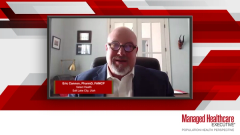
Author(s)Eric Cannon, PharmD, FAMCP
Eric Cannon, PharmD, FAMCP, discusses how the PDE4B pathway promotes inflammation and fibrosis in idiopathic pulmonary fibrosis (IPF) and progressive pulmonary fibrosis (PPF) by regulating cAMP levels and fibroblast activity. Nerandomilast has shown promising anti-inflammatory and antifibrotic effects in preclinical models, with early clinical trials suggesting good tolerability and potential lung function stabilization. However, larger phase 3 trials with longer follow-up are needed to confirm efficacy, safety and impact on disease progression.
Advertisement
Episodes in this series

Video content above is prompted by the following:
- What is the significance of the PDE4B pathway in the pathogenesis of IPF and PPF?
- What has the data demonstrated with nerandomilast so far, and what future data is needed for this therapy?
- How do you envision nerandomilast fitting into treatment algorithms for patients with IPF and PPF?
Advertisement
Related to this article
Luis Garza, M.D., Ph.D., of Johns Hopkins says cleaning off sweat can help some patients. Biologics such as Humira are used further along in treatment, but Garza said the field is still hoping for development of a disease that is specific to the disease.
Hidradenitis suppurativa is becoming more common, and a Johns Hopkins expert suspects an unidentified chemical in processed foods may be one reason.

A two-year study of 53 glaucoma patients logged nearly 4,800 home VR visual field tests, yet no insurance code currently covers home perimetry.

The pope's lung nodule was found during a routine exam. In the U.S., only 18.7% of adults eligible for lung cancer screening are up to date.
Ahead of the Health System Executive Summit, Will Carroll, chief pharmacy officer at Sutter Health, shares the system’s pharmacy strategy, its approach to building a leadership pipeline and advice for pharmacy leaders seeking a stronger executive voice.

Rex Hoffman, M.D., MBA, chief medical officer of Providence Holy Cross Medical Center, discusses his transition from radiation oncologist to hospital executive and the panel discussion that led to his new book, “Difficult Dilemmas for Chief Medical Officers: 30 Case Studies.”

Reimagine Care's CEO says one-off hospital approvals slow CAR-T access and urges buyers to ask vendors to prove outcomes such as avoided ED visits.

Foundational Pharmacy Strategies’ Christine Johnston on how rebate structures, pending legislation, and a stalled pipeline are reshaping — and threatening — the biosimilar market heading into 2027.
Advertisement
Advertisement
Trending on Managed Healthcare Executive
1
Why biosimilars keep losing ground to brand-name rivals: A Q&A with Christine Johnston, MBA
2
Pope Leo XIV's lung cancer diagnosis puts a spotlight on low U.S. screening rates
3
Chronic hand eczema needs more than topical steroids | Fall Clinical Derm 2026
4
Choosing a first biologic for HS, as recommended by Jennifer Hsiao, M.D. | Fall Clinical Derm 2026
5