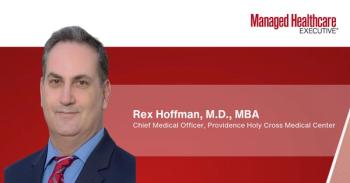
Rex Hoffman, M.D., MBA, says physician shortages and burnout are the most underestimated pressures on health system.
Evernorth’s Nicole A. Caffiero said specialty drugs dominate the pipeline, FDA approvals and the expenditures on pharmaceuticals during a keynote presentation at the AMCP annual meeting.
Cancer therapeutics and orphan drugs are no longer niche areas. Specialty drugs are now a significant portion of the prescription drug market, as well as the drug development pipeline, according to a keynote presentation today at the Academy of Managed Care Pharmacy (AMCP) annual meeting in Nashville.
"Orphan drugs continue to represent a disproportionate share of FDA approvals, accounting for more than half of all approvals in 2025, which is consistent with trends from recent years," said Nicole A. Caffiero, Pharm.D., MBA, senior clinical pharmacist at Evernorth Health Services.
“When we look ahead at the novel specialty pipeline, that pattern holds,” she said. “Cancer accounts for the largest share, representing 45% of the specialty pipeline. Orphan drugs are 40% of the pipeline, so that reflects this sustained investment in rare conditions. When you put that together, more than 85% of specialty drug development.”
The specialty drug market is undergoing a significant shift, with biosimilar competition heating up, cancer therapies becoming increasingly pinpoint and increased investment in gene therapies and innovative treatments for inflammatory conditions, multiple sclerosis, HIV, and liver and kidney disease.
The FDA approved 58 novel therapies in 2025, with 72% classified as specialty drugs and more than half having the orphan designation as treatments for diseases that affect fewer than 200,000 people in the U.S. In 2025, more than half of the expenditures on pharmaceuticals were for specialty drugs, accounting for a per-member, per-year spend of $816, according to Evernorth’s drug trend analysis. Caffiero told the AMCP audience that the FDA could approve approximately 65 new molecular entities this year and that approximately 40 (62%) of them could be in the specialty category, Caffiero said.
Oncology dominates the specialty pipeline, accounting for 45% of drugs in development, with 23 near-term therapies across solid tumors and hematologic malignancies. The shared characteristic is specificity; therapies are increasingly designed for narrow, genetically defined patient subgroups rather than broad cancer categories. Novel agents in breast cancer, non-small cell lung cancer, and bladder cancer are making their way through the drug development process, Caffiero said.
Evernorth is tracking 23 near-term cancer therapies that could come to the market in the next several years, 15 of which are in solid tumors and 8 in hematologic malignancies. “We’re seeing innovation clustering in certain cancers such as breast and non-small cell lung,” Caffiero said. “Cancers are really becoming increasingly crowded [with treatments], and differentiation is much more nuanced. At the same time, we’re seeing a lot of oral targeted therapies for rare and high unmet need cancers. Those changes will lead to different sites of care dynamics and adherence challenges.”
But as therapies become more targeted and they serve an increasingly narrow patient population, the financial risk becomes harder to distribute, she noted. Smaller populations mean costs cannot be spread broadly, intensifying cost management challenges for payers.
Metabolic dysfunction-associated steatohepatitis (MASH) is a progressive liver disease with two FDA-approved treatments, Rezdiffra (resmetirom) which is specific to MASH, and Wegovy (semaglutide), the now-famous drug that has also been approved as a treatment for Type 2 diabetes and weight loss. .
Wegovy is a glucagon-like peptide 1 (GLP-1) drug. Multiple therapies are in development to treat MASH, with potential approvals between 2027 and 2029, according to Caffiero. Three are GLP-1s. Caffiero said that the GLP-1s, which are so-called traditional drugs, are likely to become the backbone treatment for the complex disease MASH.
Other MASH treatments in the pipeline include fibroblast growth factor 21 (FGF21) analogs, an engineered version of a human hormone that targets multiple metabolic pathways simultaneously. FGF21 analogs reduce liver fat, combat inflammation, reverse fibrosis, and improve insulin sensitivity. Several late-stage agents in this class are showing strong clinical trial results, and all are administered as weekly subcutaneous injections
The FDA has approved 83 biosimilars, with approvals taking off in early 2024, mainly due to the patent losses of Humira (adalimumab), Stelara (ustekinumab), and Prolia/Xgeva (denosumab).
The next wave of biosimilars will be concentrated, Caffiero said. Drugs losing patent protection this year include Humalog (insulin lispro) with $1.8 billion in sales, Simponi (golimumab) with $3.2 billion in sales, and Xolair (omalizumab) with $3.9 billion in sales. Additionally, the blockbuster cancer drugs Keytruda (pembrolizumab), with sales of $22.4 billion, and Opdivo (nivolumab), with $7.1 billion in sales, are losing patent protection in 2028.
“What stands out to me is that through 2030, there will be first-time biosimilars for many therapeutics, and nearly $80 billion over the next five years is tied to a small number of very large biologics,” Caffiero said.
She said that although the pipeline is currently small, there is optimism that the number of biosimilars could increase because of the FDA’s biosimilar guidance that aims to reduce the development burden on manufacturers and streamline clinical requirements.
“Experts are calling this the ‘golden decade,’ because meaningful competition could emerge,” Caffiero said. “Although today the pipeline looks thin, the structural conditions for a golden decade are taking shape.”