
Opinion|Videos|December 1, 2025
Early Clinical Impact and Practical Interpretation of PHAROS Results for BRAF V600E-Mutant Metastatic NSCLC
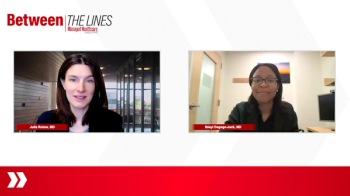
Author(s)Julia Rotow, MD , Ibiayi Dagogo-Jack, MD
This segment interprets PHAROS results in a real-world clinical context, emphasizing that despite excellent frontline activity, long-term survival remains limited by complex resistance patterns and post-progression challenges.
Advertisement
This segment transitions from numerical outcomes into practical interpretation of the PHAROS data, including how clinicians should view and apply these findings in day-to-day practice. Dr. Dagogo-Jack underscores the significance of long-term follow-up: without extended data, survival estimates for targeted therapies can be misleading or incomplete. PHAROS, with its mature dataset, provides rare clarity in a small molecular subgroup.
Both experts discuss the real-world implications of the PFS–overall survival gap, suggesting that despite excellent front-line control, post-progression options remain limited. Dr. Rotow notes that while encorafenib/binimetinib offers a major leap forward, further innovation is needed to improve long-term survival, as resistance mechanisms in BRAF-mutant cancers may mirror the complexity seen in colorectal cancer and melanoma.
The speakers reiterate that the therapy’s value extends beyond efficacy; tolerability and patient experience must also factor into treatment selection. They emphasize that BRAF/MEK inhibitors, unlike many other targeted lung cancer therapies, have distinctive adverse-event profiles requiring thoughtful monitoring.
The clinicians highlight that older adults, who represent a substantial portion of patients with BRAF-mutant NSCLC, often have comorbidities that require careful management during targeted therapy. This leads to a brief reflection on the importance of supportive care, anticipatory guidance, and multidisciplinary involvement.
While bridging trial outcomes with actual patient management, the clinicians acknowledge both the transformative nature of PHAROS and the remaining challenges.
Newsletter
Get the latest industry news, event updates, and more from Managed healthcare Executive.
Advertisement
Related Content
Advertisement








































Advertisement
Advertisement
Trending on Managed Healthcare Executive
1
HS patients on biosimilar adalimumab lose response faster than those on the original drug
2
New drug class shows promise for geographic atrophy
3
Global MS analysis links disability burden to rising economic strain
4
Early Clinical Impact and Practical Interpretation of PHAROS Results for BRAF V600E-Mutant Metastatic NSCLC
5