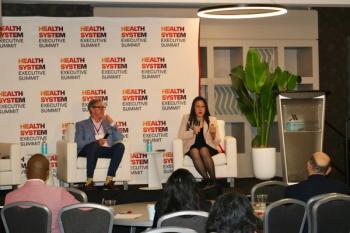
Rex Hoffman, M.D., MBA, says physician shortages and burnout are the most underestimated pressures on health system.
Survey of PEPFAR-funded organizations shows the effects of the administration's policies.
The Trump administration's disruption of the President’s Emergency Plan for AIDS Relief (PEPFAR) has resulted in the closing of 1,700 HIV/AIDS service delivery sites around the world, affecting populations most vulnerable to HIV infection, according to survey results released ahead of AIDS 2026, the 26th International AIDS Conference in Rio de Janeiro.
Findings presented at the news conference also showed that in 21 countries, 77,163 fewer children living with HIV received PEPFAR-supported treatment in 2025, when the disruptions began, than in 2024. In five countries — Uganda, Haiti, Zambia, South Africa and Kenya — the decline in PEPFAR-supported treatment was a sharp departure from preceding years, suggesting that the drop-off might be associated with changes to PEPFAR.
“Our findings document not a collapse but a narrowing of PEPFAR services concentrated among the populations and programming that, in the long term, often decide whether epidemic control is won or lost," said Elise Lankiewicz, Ph.D., M.P.H., a senior policy associate for amfAR, The Foundation for AIDS Research, the group that conducted the survey.
Started in 2003 during the George W. Bush administration, PEPFAR, fueled by a total of more than $100 billion in U.S. funding, has been credited with saving more than 20 million lives (mostly in sub-Saharan Africa) and turning the tide of the AIDS epidemic. In 2025, the Trump administration disrupted the program in two ways. When it shuttered the U.S. Agency for International Development, it closed the agency responsible for implementing many PEPFAR programs, along with partner organizations in other countries. The administration also froze all foreign aid. PEPFAR was eventually granted a waiver from that freeze, but the interruption affected many programs, and funding for prevention was slashed. According to amfAR, PEPFAR expenditures for prevention were cut by 51% from 2024 to 2025. The administration has also moved to change PEPFAR so the Centers for Disease Control and Prevention would no longer be involved, with funds going directly to countries that have signed bilateral agreements with the U.S.
In April, the U.S. Department of State released data that it said showed that the number of people living with AIDS who received antiretroviral treatment through PEPFAR-supported programs was unchanged from 2024 to 2025. The department
In a written statement emailed to Managed Healthcare Executive (MHE) yesterday, an unnamed State Department spokesman said that the department had not verified this specific report, but “we can categorically say that its methodology is flawed.”
The statement says that PEPFAR had previously measured success by how implementing partner services were funded rather than care delivered, which the statement says created perverse incentives “that keep countries dependent and global health program budgets bloated.” The Trump administration launched the America First Global Health Strategy in September 2025, which shifts global health funding to bilateral agreements. The department’s statement to MHE says that 34 bilateral agreements have been signed, representing more than $24 billion in new funding.
The statement repeats the assertion made in April that the number of people with HIV receiving treatment through PEPFAR has remained stable and that the decline in PEPFAR-supported pediatric treatment from 2024 to 2025 “tracks the broader decline in children living with HIV worldwide — hard evidence of PEPFAR’s tremendous success.” The statement says drops in the number of children who received PEPFAR-supported HIV treatment in South Africa and India reflect limitations of the data, “not a real change in the number of children receiving HIV treatment.” The State Department statement also accuses South Africa of choosing to “prioritize continued state-sponsored racial discrimination over PEPFAR assistance.”
The findings from amfAR, which were presented in a
In circumstances where funding has been preserved, the Trump administration has put restrictions related to gender, diversity, equity and inclusion, along with “requirements to stop or scale back services for populations most vulnerable to HIV," Lankiewicz said during the news conference conducted via Zoom. “The PEPFAR that survived is not necessarily the PEPFAR that existed before.”
amfAR and several partner organizations, operating under the name PEPFAR Pulse study team, surveyed country-level PEPFAR “implementing partner” organizations from November 2025 to April 2026. They received responses from 23% (166 of 708) of the organizations. Lankiewicz said the respondents were representative of the PEPFAR implementing partners, although local nongovernmental organizations might have been slightly overrepresented. As reported in the abstract, the responses showed that 3% (5 of 158) of the organizations closed permanently, 52% (82 of 158) had at least one PEPFAR award canceled, and 81% were asked to restrict their work to comply with U.S. policy.
In its report, amfAR said that the administration has reinstated the policy — known as the Mexico City policy — that bars foreign nongovernmental organizations that receive U.S. funds from providing or promoting abortion even when they do so with non-U.S. funds. In January 2026, the administration also required that aid recipients not provide gender-affirming care or have diversity, equity and inclusion programming, according to amfAR.
Of the 1,714 service sites closed because of PEPFAR award cancellations, 1,010 were public health facilities, 325 were access points and 126 were drop-in centers, amfAR reported.
Although the disruption was greater in programs geared toward prevention, amfAR’s survey showed that among the 85 programs providing treatment, 18 (21%) stopped at least one HIV clinical care activity.
The amfAR report credits PEPFAR’s success at curbing HIV transmission to programs geared toward hard-to-reach populations, including what are identified as "key populations” by HIV/AIDS researchers and advocates: sex workers, men who have sex with men, transgender populations and people who inject drugs. The survey showed that outreach services specific to key populations were most likely to be stopped permanently as a result of PEPFAR disruptions.
Organizations had some success in finding alternatives to PEPFAR money. Just under half (49, or 44%) of the programs that had at least one delayed or canceled award from PEPFAR identified other funding after they lost U.S. funding, according to the amfAR report. But almost all (47 of 49) indicated that the alternative funder provided less support than PEPFAR had.
The meaning behind data showing declines in the number of children with HIV on treatment has become a bone of contention. In April, the State Department said the decrease has been misrepresented and is actually “a sign of the tremendous progress that has been made reducing the incidence of mother-to-child transmission of HIV and is consistent with historical trends.”
At the virtual press conference, Ramona Godbole, M.A., M.H.S., a researcher at the Heidelberg Institute of Global Health, didn’t totally dismiss that assertion after presenting data showing a decrease in PEPFAR-supported treatment of children with HIV.
“A decline in PEPFAR-supported pediatric treatment isn’t inherently bad news,” Godbole said. “It usually means fewer babies are being born with HIV because our prevention of mother-to-child transmission has worked.” Godbole added that the PEPFAR treatment cohort has been contracting for the past few years.
But Godbole and her colleagues’ analysis of data that came from PEPFAR shows a steeper decline from 2024 to 2025 than in the recent past in Uganda, Haiti, Zambia, South Africa and Kenya.
“While this analysis can’t tell us what happened to individual-level treatment status or population coverage, our country-level results do challenge broad assertions of program stability,” Godbole said.
Godbole and her colleagues limited their analysis to treatment funded by PEPFAR at the treatment-site level, excluding individuals on treatment that benefited from broader, national levels. In the abstract summarizing their research, they said they did so because of inconsistencies in the way that central support funding is reported.
The steepest decline in the absolute number of children with PEPFAR-supported treatment occurred in South Africa, where, according to what Godbole and her colleagues analyzed, 31,000 fewer children were treated in 2025 than in 2024. In Zimbabwe and Kenya, 6,000 fewer children had PEPFAR-supported treatment. South Africa and India, at 40%, had the steepest declines by percentage.