In this discussion, Ohio State economist Eric Seiber, Ph.D., explains how inconsistent claims-data definitions can skew estimates of first-episode psychosis and why standardization matters for early treatment and sustainable payment models.
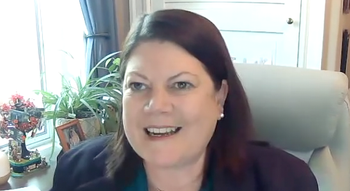
In this discussion, Heather Burrell-Ward, M.D., provides an overview of her recent study that found TMS aimed at the default mode network improved processing speed in schizophrenia.
Transcranial magnetic stimulation (TMS) may be the future of psychiatric treatment, according to the results of a recent study in which five TMS sessions improved the cognitive symptoms of schizophrenia.
The study, titled, ‘Accelerated DMN-targeted cTBS improves processing speed deficits in schizophrenia,’ was published in
Corresponding author, Heather Burrell Ward, M.D., assistant professor of psychiatry and behavioral sciences and director of neuromodulation research at Vanderbilt Health, recently sat down with Managed Healthcare Executive to explain the study’s findings and why she finds them “exciting.”
This interview has been edited for length and clarity.
MHE: What is TMS?
Burrell Ward: TMS stands for ‘transcranial magnetic stimulation.’ It's a form of non-invasive brain stimulation that involves a coil often in the shape of a figure-eight. It's made up of copper wires, and what happens is you pulse an electrical current through those wires, and that generates an electromagnetic field, and when you place the coil on someone's scalp, and it causes the neurons to fire right underneath that coil. You can use TMS to upregulate brain activity or to downregulate it.
There's a lot of research going on in the use of TMS because it's so versatile, because you can place it almost anywhere on the scalp. TMS is FDA-cleared for the treatment of major depression, for obsessive-compulsive disorder and most recently for smoking cessation. It was first FDA-cleared for depression in 2008, so it's being used really every single day in clinics across the U.S. For depression, we place the coil over the left dorsolateral prefrontal cortex. For this study, we placed the coil over the parietal cortex.
MHE: How, and why, did you use TMS in your recent study?
Burrell Ward: I am a psychiatrist who studies schizophrenia. People with schizophrenia suffer from cognitive deficits, and the current medications don't treat the cognitive deficits. Sometimes they actually make them worse. I see people in the clinic every week who have schizophrenia, and they're struggling with attention, concentration and their speed of processing and we have very little to offer them. Schizophrenia is a brain disorder that is characterized by abnormal brain activity across brain networks, and so there are certain brain networks that are involved in cognitive performance. Some networks must activate when you're doing a particular cognitive task, and some have to be suppressed. We know that in schizophrenia, the network that needs to be suppressed when you're doing a task is called the default mode network. In the study, we thought, if we could use TMS to down-regulate that network, then maybe that would improve cognitive performance. So, we did two studies. The first one we tested was just a single session of TMS. TMS sessions can vary anywhere from 1 minute up to 40 minutes, depending on the protocol that you're using. The initial protocols that were implemented in 2008 were 37 minutes. The one that we used was only about a minute, but it did not improve cognitive performance. For context, treatment of depression may involve up to 36 treatments to get a durable improvement in depression.
In our second study, we scaled it up to five sessions. We did see improvements in cognitive performance, specifically in processing speed, which is one of the cognitive domains that is most severely affected in schizophrenia. Importantly, the changes that we saw in cognitive performance were related to changes in the default mode network.
MHE: What does TMS feel like?
Burrell Ward: I train all my research assistants in my lab, and they practice on me. TMS feels a tapping on your head, and then a kind of pinching. The first session can be uncomfortable because it's not a sensation they’re used to feeling, but people usually acclimate within a couple of sessions.
MHE: What is one thing that you want readers to take away from this study?
Burrell Ward: In psychiatric disorders, we are learning that by understanding the brain circuitry driving different symptoms, we can develop effective, safe treatments for localized symptoms.
TMS is exciting because you could personalize it to a particular patient's symptoms—you could give them TMS for cognitive impairment, or you could apply TMS to a brain circuit involved in auditory hallucinations. The possibilities are endless.
MHE: What is the next step for this study?
Burrell Ward: We just got funding from the Sidney R. Baer, Jr. Foundation to further develop TMS for cognitive deficits in schizophrenia. So, one session didn't do anything, and after five sessions, we started to see improvement. The goal is to scale this up to more sessions of TMS to produce a more durable effect. I think of it like exercising. If you do one workout, you're probably not going to get that much long-term benefit. If you do five workouts, that helps. But if you get to 30 or 40 workouts, then you're more likely to have a more durable effect. So, the next step really is to scale this up to more sessions of TMS and see if we can get more improvement in cognitive performance and to see if we can get improvements that last months and eventually, years.